There is a particular kind of grief that does not announce itself as grief. The men and women who climbed onto the road to Babylon in the spring of 597 BCE did not know they were founding something. They knew only that Jerusalem was behind them, the Temple still standing but humiliated, and that their king - the young Jehoiachin, eighteen years old and only three months on the throne - was walking the same road in chains. They were the first of the exiled: the royal household, the priests, the craftsmen, the soldiers, "all the mighty men of valour" (2 Kings 24:14). Ten thousand people. The cream of a small kingdom, carried off.
What they carried with them, packed into memory because you cannot chain a song or confiscate a text, was the seed of something Babylon could not have anticipated: a religion that would learn to live without its land. Every subsequent form of Jewish life - synagogue prayer, Torah study, the idea that the sacred is portable - has its roots in those bewildered months on the road between Judah and the great river cities of Mesopotamia.
The record
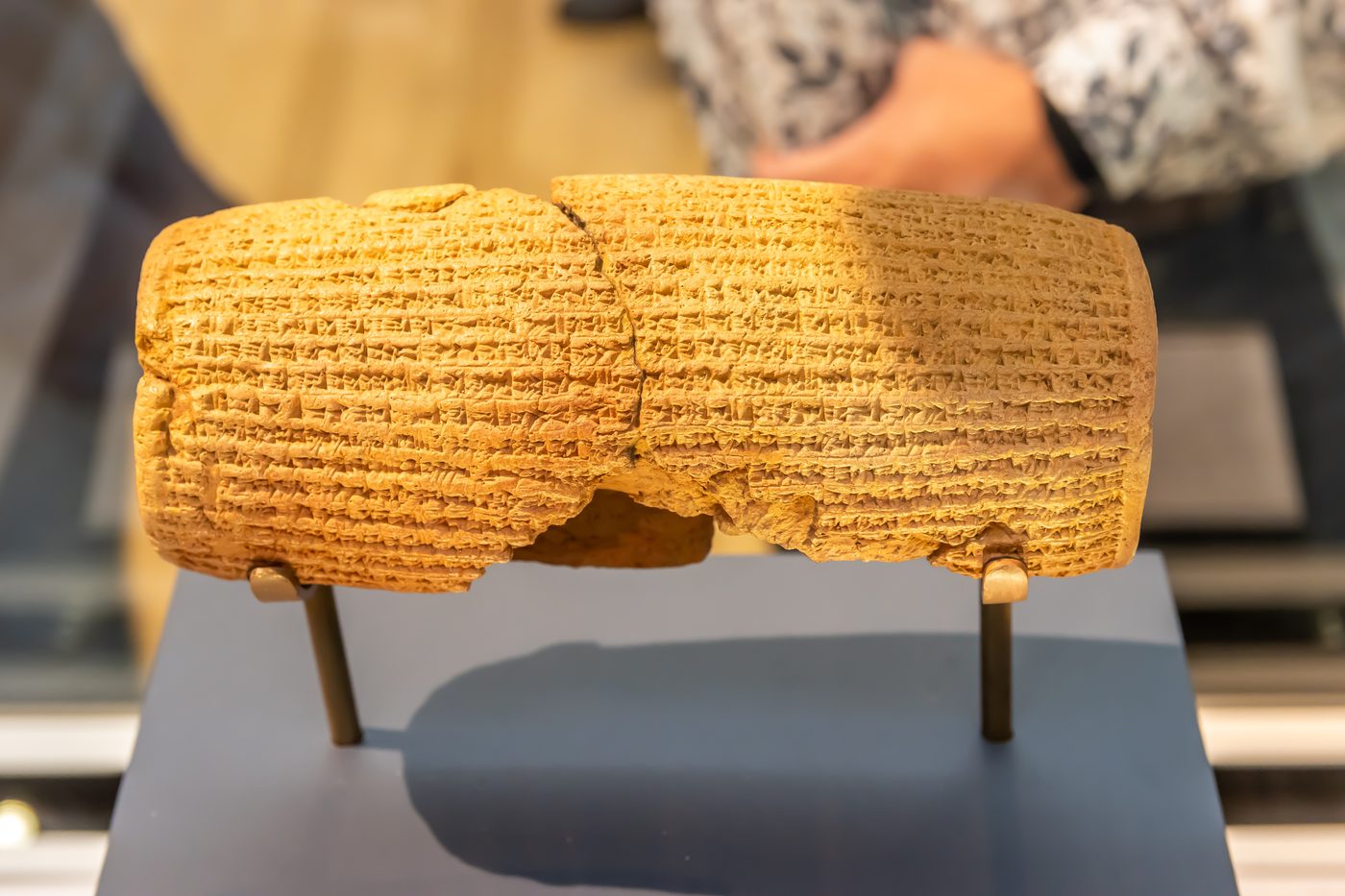
The Babylonian Chronicle (British Museum tablet BM 21946, known as Chronicle 5) records in Akkadian cuneiform that in the seventh year of Nebuchadnezzar II's reign - corresponding to 597/596 BCE - "he marched to the land of Hatti [the Levant], besieged the city of Judah, and on the second day of the month of Adar he took the city and captured the king. He appointed therein a king of his own choice, received its heavy tribute and sent it to Babylon." The tablet, acquired by the British Museum in 1896 and first published by Donald Wiseman in 1956 (Chronicles of Chaldaean Kings, British Museum Press), is one of the rare cases where a biblical narrative is corroborated word-for-word by a contemporary Babylonian document.
Jehoiachin spent thirty-seven years as a prisoner in Babylon - long enough to appear in the palace ration tablets discovered by Ernst Weidner in the Ishtar Gate excavations, listed among the workers and captives receiving oil and grain from the royal stores. His name appears as "Ia-u-kînu of the land of Ia-a-hu-du." He was not forgotten in Judah; the book of Jeremiah preserves the faint but stubborn expectation that a scion of David's line would one day return. That expectation was not naive politics. It was theology doing what theology does best: keeping a people together across an impossible distance. The exiles maintained their genealogies, their feast days, their identity as a distinct community. Ezekiel prophesied on the banks of the Chebar canal. Psalm 137 was composed somewhere along those same waterways: "By the rivers of Babylon, there we sat down and wept." The grief was real. So was the defiance.
The record
Babylonian administrative tablets excavated from the vaulted archive rooms near the Ishtar Gate in Babylon - published by Ernst Weidner in 1939 in Mélanges syriens offerts à René Dussaud - include ration lists from circa 592 BCE naming "Ia-u-kînu, king of the land of Ia-a-hu-du" and five royal sons, all receiving allocations of oil. The texts confirm that Jehoiachin (2 Kings 24) was held in Babylon under a form of house arrest rather than hard imprisonment, and that his household retained a recognised identity. The tablets are held across collections in Berlin (Vorderasiatisches Museum) and the Pergamon Museum.
The first exile lasted a little over a decade before Nebuchadnezzar returned and completed the destruction in 586 BCE. But it was this first carrying-off that broke the mental model. Jerusalem had fallen before to conquerors who moved on; this time, Judah's best were taken with them and not returned. The shock cracked something open. Into that crack poured everything Judaism would become when the Temple was finally gone for good: the idea that a people defined by covenant rather than geography could survive anywhere, could thrive anywhere, could carry the sacred in a scroll instead of a stone. Catastrophe, as this people has learned to say, can be a furnace - and the alloy that emerges from it tends to be harder than what went in.
The cuneiform tablet in the British Museum is three inches of dried clay. The empire that made it lasted another sixty years. The community it inadvertently documented is still here.