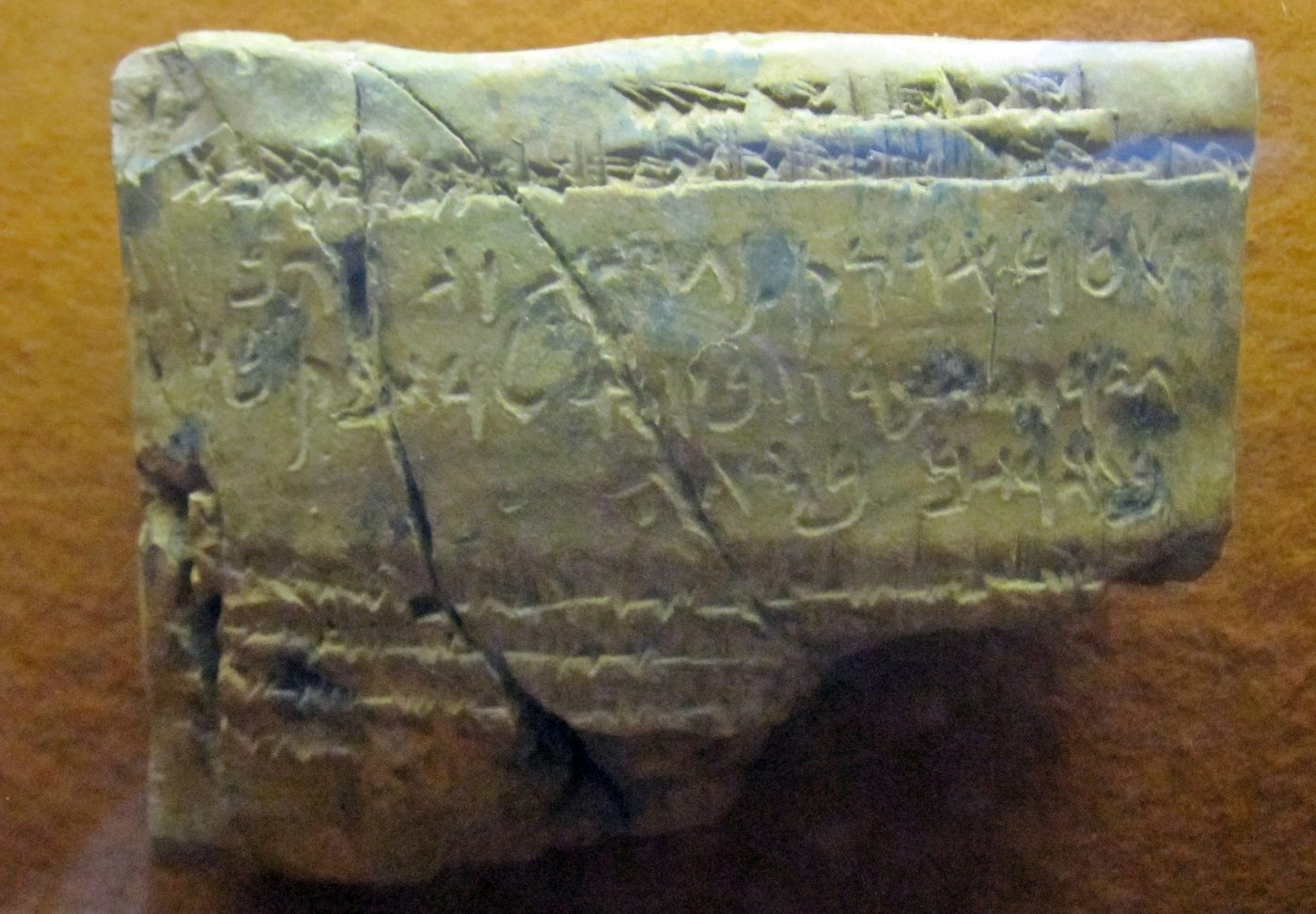
Before the exile, Hebrew was written in its own ancient hand - the Phoenician-derived alphabet whose graceful curves we now call the paleo-Hebrew or "Old Hebrew" script. You can see it on the Siloam Tunnel inscription, on the Gezer Calendar, on the potsherds from Lachish. It was the script of the monarchy, of the Temple bureaucracy, of everything that was destroyed when Babylon came. Then the community that survived came home. They came home fluent in Aramaic, the administrative language of the entire Near East, and they came home knowing Aramaic's alphabet - the squarer, more angular letter-forms that scribes from Egypt to Persia used to write on papyrus and on clay. That script travelled with the returnees and, over the following generations, displaced the older hand almost entirely for sacred writing. What looks like loss - borrowing another nation's alphabet - turned out to be the vessel that carried the Torah through every century that followed.
The switch was not a single decree. It happened the way language always changes: gradually, in scribal schools and court offices and synagogue reading-rooms, the newer forms crowding out the older until the older became archaic, then ceremonial, then forgotten by most people. By the time the Talmud was redacted, the rabbis already treated paleo-Hebrew as a distinct, half-exotic system. Tractate Sanhedrin records a debate about whether Torah scrolls written in the old script or in other languages retain their sanctity - which implies that by the tannaitic period (roughly 1st-3rd century CE) the square Assyrian script, the Ketav Ashurit, was so completely the norm that the old forms had become a special case requiring discussion. The Mishnah's answer is careful: the Ketav Ashurit is the authoritative form, and it was given to Israel at Sinai - a claim that sacralises the script that came from Babylon by grounding it in the deepest origin story the tradition possesses.
The record
The transition from paleo-Hebrew to the square Aramaic script is documented in the Dead Sea Scrolls (discovered at Qumran 1947-56, now in the Israel Museum, Jerusalem, and the Shrine of the Book). The great majority of the roughly 230 biblical scrolls in the collection - dated between approximately 250 BCE and 68 CE - are written in the square Aramaic-derived script. A small number, including fragments of Leviticus and Numbers, are written in paleo-Hebrew, suggesting that by the late Second Temple period the old script had become a self-conscious archaism used for prestige purposes or for particular holy texts, while the square script had become standard. The earliest Qumran manuscripts in square script are conventionally dated to the 3rd century BCE, showing that the script had taken hold well before the late Second Temple period. (Israel Antiquities Authority; Frank Moore Cross, "The Development of the Jewish Scripts," in The Bible and the Ancient Near East, 1961.)
There is a detail in Tractate Sanhedrin 21b-22a that stops you in your tracks. The Talmud records a tradition attributed to Mar Zutra (and others) that the Torah was originally given to Israel in the Ketav Ashurit - the Assyrian square script - but that when Israel sinned, it was changed to Ro'atz (a term scholars interpret as a cruder, rounder hand), and when Ezra came up from Babylon, he restored it to the Assyrian script. The tradition is theological, not historical, and different rabbis dispute it. But it does something striking: it rewrites the Babylonian exile as a restoration rather than an introduction. The script that came home with Ezra did not arrive from outside; it returned to its proper place. Whatever the historical reality - and the archaeology suggests the square script was indeed Aramaic in origin - the tradition shows a community that had integrated a profound cultural change into its self-understanding so completely that the borrowed thing had become the original thing. That is an act of civilisational confidence, not of assimilation.
The record
The Aramaic square script from which the Jewish Ketav Ashurit derives is attested on Aramaic papyri from Egypt dating to the 5th century BCE - the same period as Ezra's mission to Jerusalem (conventionally dated c. 458 or 398 BCE). The Elephantine Papyri, a cache of Aramaic documents from a Jewish military colony on the Nile, discovered 1898-1907 and now held across several collections including the Egyptian Museum in Berlin and the Brooklyn Museum, show the script in everyday administrative use. They include letters to the High Priest in Jerusalem and petitions to the Persian governor - Jewish community documents written entirely in the square Aramaic script already, in the same generation that brought the script back to Judah. The Elephantine archive is thus a living cross-section of the moment: diaspora Jews conducting their religious and legal affairs in Aramaic letters, in exactly the hand their counterparts were carrying back into the land. (Bezalel Porten, The Elephantine Papyri in English, Brill, 1996.)
Today every Torah scroll in every synagogue in the world is written in the Ketav Ashurit - the same squared, carefully ruled letters that a Babylonian exile brought back to Zion around 450 BCE. The sofer, the Torah scribe, trains for years to render each letter in precise accordance with the transmitted form; a single malformed letter can render an entire scroll invalid. What looks from the outside like an ancient, unchanging tradition is, in its deep history, a deliberate adoption - a community taking the best tool available and making it wholly its own. The script came from Babylon. The Torah was already there. The combination produced something neither source could have predicted: a written tradition durable enough to carry a people through every dispersal that followed.
The old paleo-Hebrew alphabet did not disappear entirely. It survived on coins - the Hasmoneans and the rebels of 66-70 CE struck coins with paleo-Hebrew lettering, a pointed assertion of antiquity at moments of national assertion. It survived in a handful of Qumran manuscripts as a marker of special sanctity. It survives today in the parchment mezuzah tag bearing the letter shin, and in the ornamental traditions that reach back through centuries of manuscript art. The square script became the instrument; the older hand became the symbol. Both belong to the same story.