Four centuries is a long time to go without a country of your own. The Babylonians had come in 586 BCE, then the Persians, then the Greeks of Alexander, then the squabbling Ptolemies and Seleucids who treated Judea as a pawn between Egypt and Syria. Generation after generation, Jewish life continued - the Torah was studied, the Temple served, the calendar kept - but the land was always someone else's. The tribute went north to a foreign court. The decrees came down in Aramaic or Greek. And in the Acra, the great citadel Antiochus IV had built inside Jerusalem to oversee the Temple Mount, a Seleucid garrison sat like a splinter that no one had yet been able to pull out.
Then came Simon. The last surviving son of Mattathias the priest, younger brother of Judah Maccabee the warrior and Jonathan the diplomat, Simon had watched his family fight and bargain and die to reclaim what Israel had been. He would be the one to finish it. In 142 BCE, under a deal struck with the Seleucid king Demetrius II Nicator, Simon won the thing his brothers never quite achieved: formal remission of tribute and formal recognition that Judea owed nothing more to the empire. "The yoke of the nations was lifted from Israel," the book of 1 Maccabees records in a phrase that sounds like a breath finally released. And then the Acra fell - not by siege but by negotiation and starvation - and the garrison marched out, and Simon entered with palm branches and psalms and a lute.
The record
1 Maccabees 13:41-42 (composed c. 100 BCE, preserved in Greek translation in the Septuagint) states: "In the one hundred and seventieth year the yoke of the heathen was taken away from Israel. And the people of Israel began to write in their instruments and contracts, In the first year of Simon the High Priest, the Renewer of the people, the Commander and Ethnarch of the Jews." The "hundred and seventieth year" is the Seleucid Era reckoning for 142 BCE. The Acra's fall is recorded separately at 1 Maccabees 13:49-52 as occurring on 23 Iyyar - a date still commemorated in the ancient festival calendar preserved in Megillat Taanit.
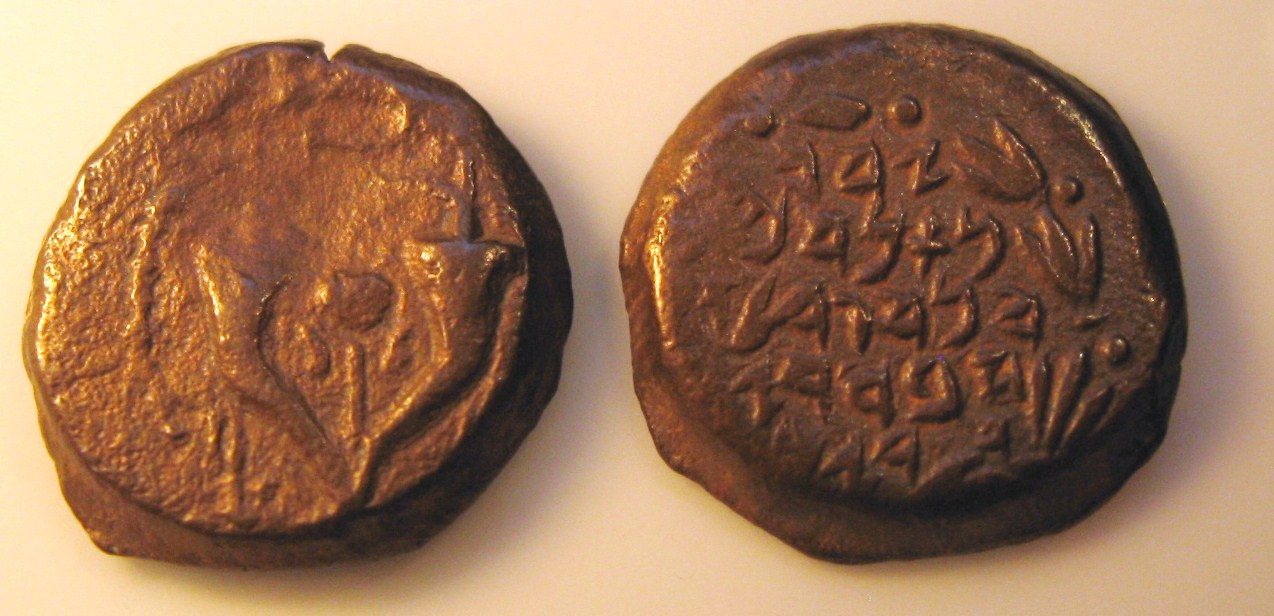
What strikes you, reading those verses, is the detail about the contracts. Not just the grand political statement - the ordinary legal paperwork of daily Jewish life suddenly carries a new date. "In the first year of Simon." A farmer recording a land transfer, a merchant setting out a loan agreement, a couple drawing up a marriage contract: all of them now counted the years from a Jewish leader's name. The symbolic weight is immense. A people count time by the rulers they acknowledge. For four centuries the years had been numbered by foreign kings. Now they were numbered by one of their own. A year later, at a great public assembly in September 141 BCE, that status was formalised still further: Simon was declared High Priest, Ethnarch, and military commander - the triple office uniting the religious and civic authority of the nation in one hereditary role. The coins his son John Hyrcanus would later strike still carry the declaration in ancient Hebrew script: "Yehohanan the High Priest and the Council of the Jews." That coin is the small change of sovereignty.
The record
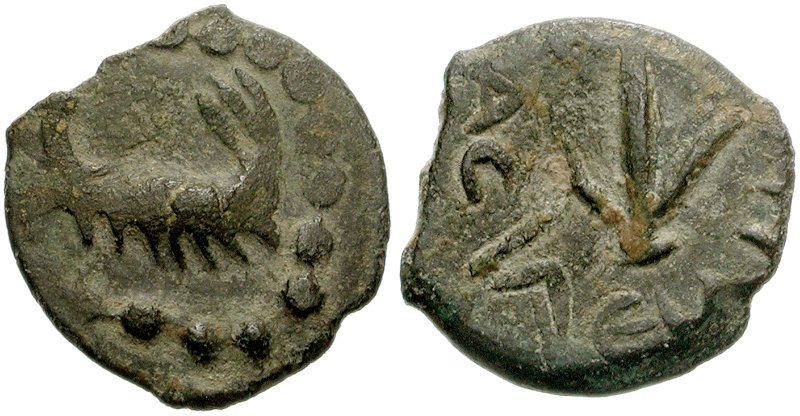
The public decree formalising Simon's authority is recorded in 1 Maccabees 14:27-45, and Josephus summarises it in Antiquities of the Jews XIII.6-7 (written c. 93 CE). The assembly was held "on the eighteenth of Elul, in the hundred and seventy-second year" - September 141 BCE. The decree established that Simon's high priesthood and command were to be hereditary "until a faithful prophet should arise" - a clause that acknowledged the decision's provisional character while securing it in practice for generations. Physical evidence of the new dating system survives in bronze coinage: Hasmonean prutot bearing paleo-Hebrew legends (rather than Greek), catalogued in Ya'akov Meshorer's standard corpus A Treasury of Jewish Coins (2001), show that Simon's dynasty self-consciously revived the ancient Hebrew script as a mark of national authenticity.
Simon himself did not grow old in his freedom. He was murdered three years later by his own son-in-law, at a banquet, in a dynastic betrayal that casts a shadow over the Hasmonean story that never quite lifts. But what he achieved in 142 BCE - the removal of foreign tribute, the expulsion of the garrison, the renaming of the years - those held. Judea remained independent, under Jewish rule, for nearly eighty years, until the Roman general Pompey walked through an open gate in 63 BCE. Eighty years is not forever, but for a people who had waited four centuries, it was something real. They dated the years to Simon. That is how a nation marks its own beginning.