He came to the throne not by design but by default. Alexander Jannaeus was a third son, kept away from Jerusalem by his brother John Hyrcanus I, and when both his brothers died in quick succession in 103 BCE, the crown and the high priesthood fell to him together. He was about twenty-two years old. What followed was twenty-seven years of almost continuous war - against the coastal cities, against the Nabataeans to the south and east, against Seleucid remnants in the north, and, most painfully, against his own people at home. By the time he died in 76 BCE, Judaea had become something that would not exist again in Jewish history for nearly two thousand years: a territorial state of recognisably biblical proportions, stretching from the Golan Heights to the Negev, from the Jordan Valley to the Mediterranean coast.
His Hebrew name was Yehonatan - Jonathan - and he used it on his coins even when the Greek name Alexander served the wider world. That insistence on both registers, Greek and Hebrew, Hellenistic king and Jewish high priest, was the defining tension of the man and of the Hasmonean house at its peak. He was never comfortable in only one skin. The Pharisees who opposed his combining of royal and priestly roles were not wrong that the combination was awkward. He was not wrong that the combination was powerful. The quarrel between them would cost blood on both sides before it was done.
The record
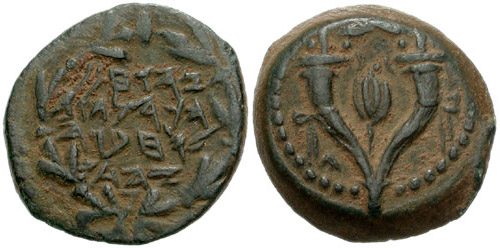
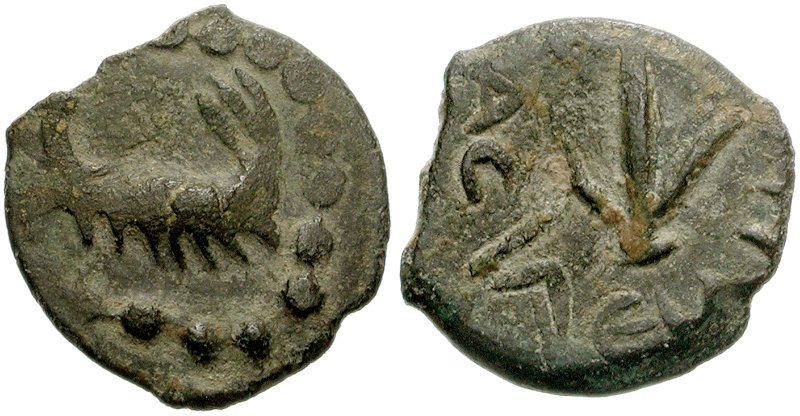
The coins of Alexander Jannaeus are the most abundant Hasmonean numismatic finds in the archaeological record of the Land of Israel. The Israel Antiquities Authority and the Israel Museum both hold substantial collections. His bronze prutot (small denomination coins) were struck in two scripts simultaneously - Paleo-Hebrew naming "Yehonatan the King" and Greek naming "King Alexander" - reflecting the bilingual Hellenistic Jewish world of Hasmonean Judaea in the late second and early first centuries BCE. Josephus, in Antiquities of the Jews (Book XIII), provides the primary ancient narrative of Jannaeus's campaigns and reign.
The campaigns were real and the territory was real. Josephus lists them with the detail of someone who had access to court records: Gaza taken after a siege of a year, the Greek coastal cities subdued, Gadara in the Transjordan, Pella, Gerasa. In the north, settlements in the Golan and Galilee. In the south, the Negev and parts of the Nabataean frontier. The map that emerges is startling for anyone who knows the modest Judaea of the Persian and early Hellenistic periods - a hill-kingdom squeezed into the central highlands. Jannaeus pushed that border outward in almost every direction. He was not always successful; he suffered defeats, including a serious one near Gadara where his losses were catastrophic. He came back. He always came back. That capacity to absorb military disaster and return to the field was part of what made him so dangerous to his neighbours and, in the end, what exhausted his own people.
The record
The internal civil conflict of Jannaeus's reign is documented by Josephus (Antiquities XIII.13-14 and Jewish War I.4): opponents, identified as Pharisees and their supporters, rose against him and at one point invited the Seleucid king Demetrius III Eucaerus to intervene - an episode in which a Seleucid army defeated Jannaeus in battle c. 88 BCE. Josephus records that after his eventual suppression of the revolt, Jannaeus crucified eight hundred captives. The passage in the Dead Sea Scrolls commentary on the book of Nahum (4Q169, the Nahum Pesher, held at the Shrine of the Book, Israel Museum, Jerusalem) is widely understood by scholars including Geza Vermes and Frank Moore Cross as a contemporary reference to this crucifixion, describing someone who "hangs men alive" - a rare surviving echo of Jannaeus in a text written by his contemporaries.
His death in 76 BCE came on campaign - Josephus says he died of fever at the siege of Ragaba east of the Jordan, still fighting. He left the kingdom to his wife Salome Alexandra, with whom he seems to have reached a pragmatic understanding in his final years: she would reconcile with the Pharisees, and the state he had built by the sword would be governed by law. It was, by any measure, a strange and rich ending to a violent reign. The kingdom lasted. The borders Jannaeus had drawn by conquest held, more or less, under Salome's nine years of capable rule, before the sons' civil war and then Pompey's arrival in 63 BCE collapsed the whole Hasmonean structure. What Jannaeus built was not permanent. But for one long, turbulent generation, the tribe of Israel held a country of biblical scale, minted its own coins in its own language, and fought its own wars under its own king. That is not nothing. In the long account of Jewish political life, it is rather a great deal.
History has not been kind to Jannaeus, and some of that judgement is earned. The crucifixions are not rumour. The civil war deaths were real. But the kingdom he assembled was also real, and it was built by a Jewish king working within Jewish political categories - not a client, not a vassal, not a community leader managing decline, but a monarch in full, fighting for territory and winning it. The Hasmoneans at their height remind us that Jewish political ambition and Jewish land have a history together that stretches well beyond 1948. Jannaeus was its most expansionist expression.