It begins, as these stories often do, with a hatter. In 1812 a man named Isaac Cohen was admitted as a burgess of Glasgow, the first Jew the city's records can name, and around him over the next decade gathered enough men for a minyan in a High Street tenement. From that small room came a community that would build Scotland's first purpose-built synagogue, fill a riverside slum with Yiddish, and then climb the hill out of it into the southern suburbs where it lives today. Glasgow is a modest Jewish city by the standards of the world. By the standards of Scotland it is the whole story.
The shape of that story is a journey across the city - from the High Street to the Gorbals to Garnethill, and finally south to Giffnock and Newton Mearns. Each move was a kind of arrival. A community that keeps relocating its centre is not a community in retreat. It is one following its own families, which is the only direction worth following.
The Gorbals years
The first families were Dutch and German merchants, settled and respectable. The community that made Glasgow properly Jewish came later and poorer, fleeing the pogroms of the Russian Empire from the 1880s, mostly Lithuanian, Polish and Ukrainian, off the boats and into the cheapest housing they could find. That housing was the Gorbals, a dense working-class district on the south bank of the Clyde, and for the better part of a century it was Jewish Glasgow. Tailors and pedlars and small traders, a tangle of small synagogues, Yiddish on the street: by the First World War some nine thousand Jews lived there.
The Gorbals was not a place anyone romanticised while living in it. It was overcrowded and hard. But it did the work that immigrant quarters do - it held a frightened, foreign-speaking population together long enough to put down roots, school its children, and build the institutions that would let the next generation leave. When the city demolished the Gorbals in the 1960s, the Jewish community had already largely moved on, which is exactly what the Gorbals had been for.
Scotland's first purpose-built synagogue
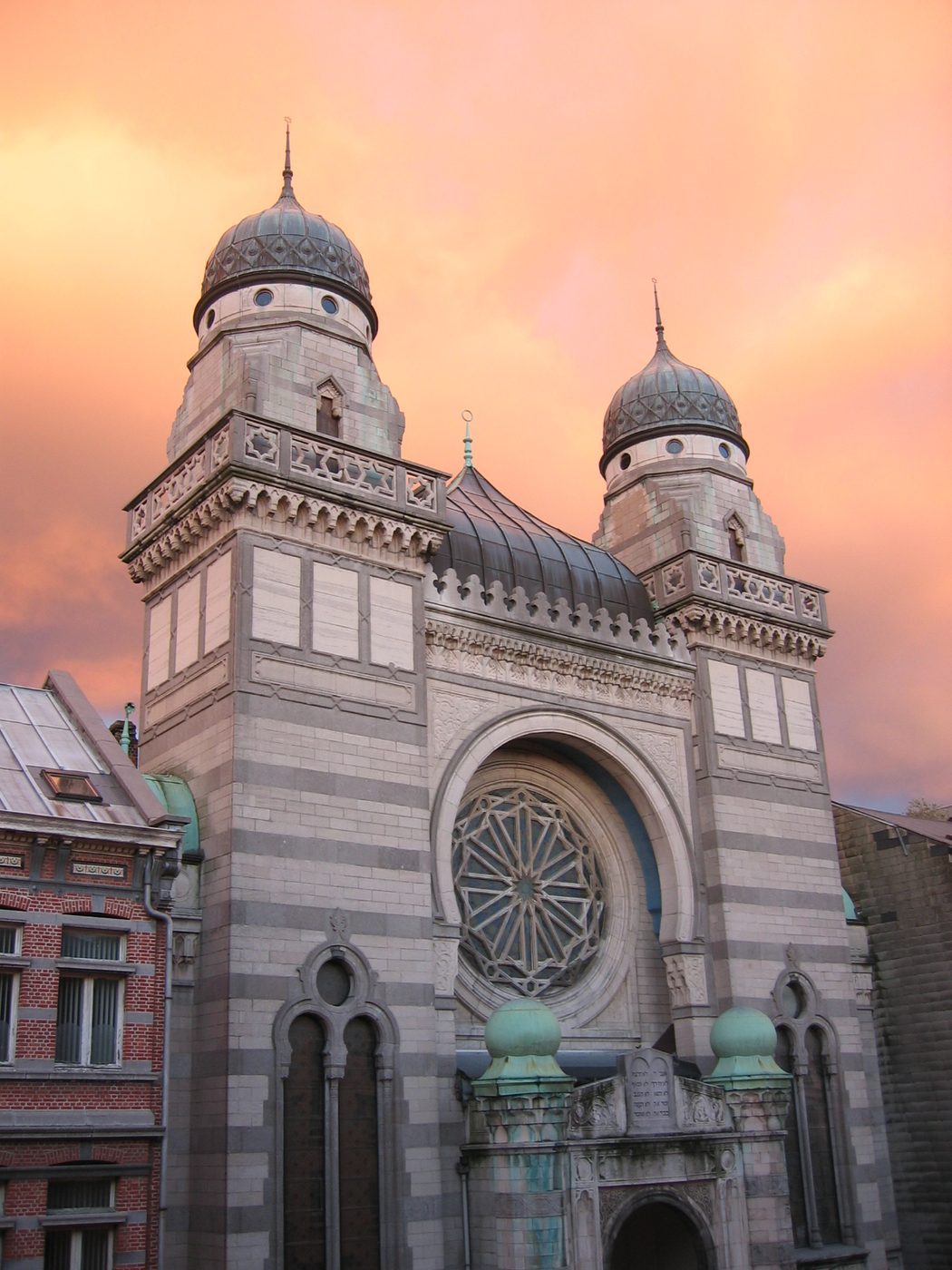
Garnethill Synagogue, on a hill above the city centre, was consecrated on 9 September 1879, the first purpose-built synagogue in Scotland. It was designed by the Glasgow architect John McLeod in collaboration with the London synagogue architect Nathan Solomon Joseph. Built for the established, upwardly mobile families rather than the Gorbals immigrants, it is still the oldest synagogue in active use in Scotland and now houses the Scottish Jewish Archives Centre.
Garnethill Synagogue; Scottish Jewish Archives CentreAt its height, around the middle of the twentieth century, the community ran to something between fifteen and twenty thousand people, the great majority of Scotland's Jews. It produced its share of the country's life out of all proportion to its size. Isaac Wolfson, born in the Gorbals to Polish immigrants, built a retail empire and a foundation that still gives away his money. The sculptor Benno Schotz became Her Majesty's Sculptor in Ordinary for Scotland. Myer Galpern served as Glasgow's first Jewish Lord Provost. A small community on a northern river kept producing people the wider country could not do without.
A community that keeps relocating its centre is not a community in retreat. It is one following its own families.
Where the community lives now
The 2011 census recorded 5,887 Jews by religion in Scotland, with the single largest concentration in East Renfrewshire - the suburbs of Giffnock and Newton Mearns just south of Glasgow - where about two in five of Scotland's Jews live. The 2022 census put the national figure at roughly 5,500. Glasgow remains the heart of Jewish Scotland, with Calderwood Lodge, the country's only Jewish primary school, and the largest synagogue in Scotland at Giffnock.
Scotland's Census; Scottish Jewish Archives CentreA city that stayed
The grand fact about Jewish Glasgow is that it is still here. Plenty of immigrant communities its size scattered and dissolved within a few generations, leaving a cemetery and a street name. Glasgow's did not. It carried its institutions across the river and up the hill, kept its school and its synagogues and its welfare charity going, and is now smaller than its mid-century peak and entirely intact. The Gorbals is gone. The community it incubated is at synagogue in Giffnock this morning.
There is a particular satisfaction in a story that ends not with a flourish but with continuity. No one writes ballads about a Jewish community that simply kept being a Jewish community, generation after generation, in a rainy northern city far from any centre of the Jewish world. But that is the achievement, and it is not a small one. Glasgow stayed.
Further reading
Story & Stone · Atlas Places Nº 25
Next on the shelf: Seoul: A Small, Visible Community →