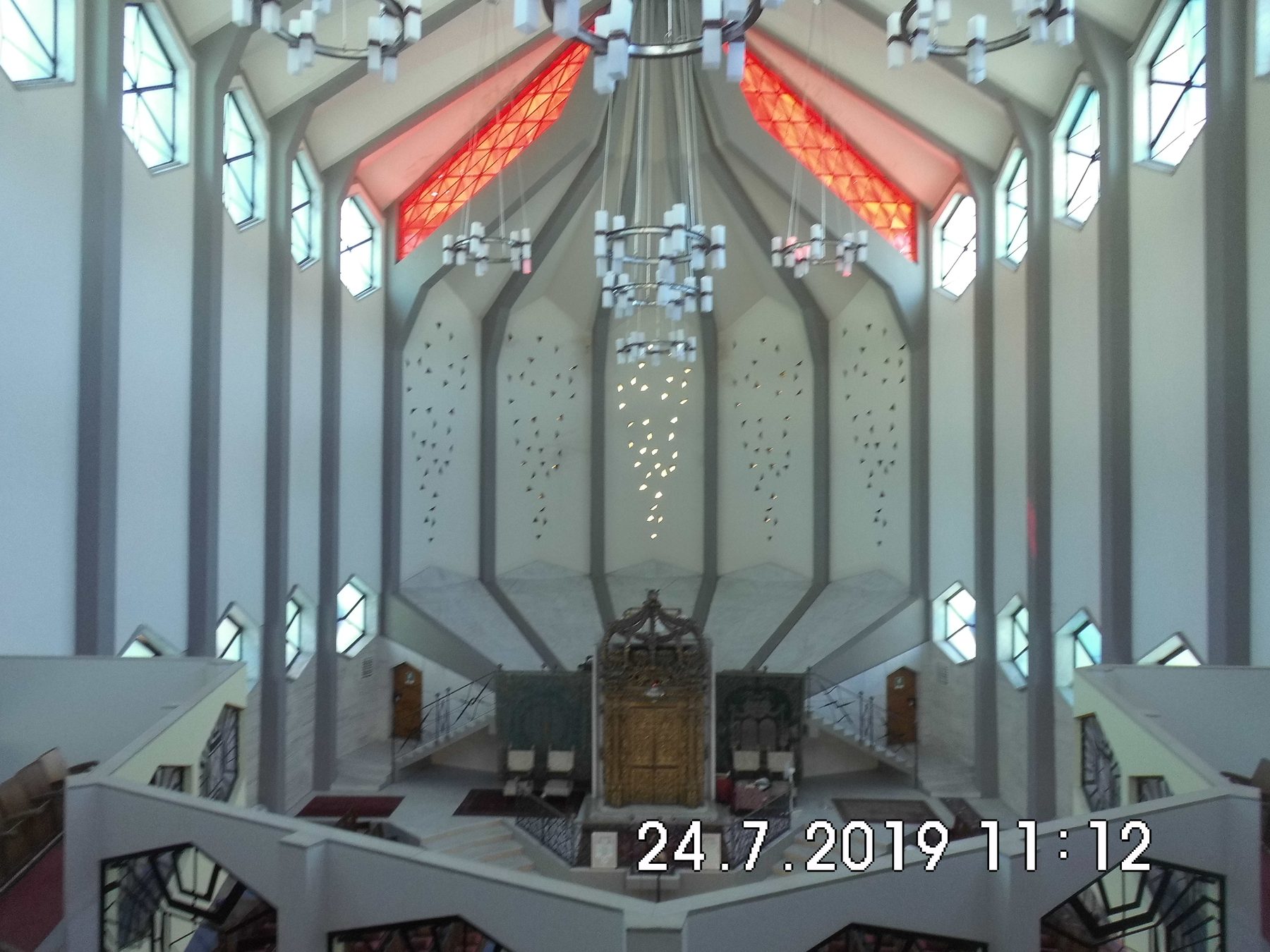
It is one of the better Jewish jokes in architecture that a community so important to the Americas made its great statement in sand. Not marble, not paving, not imperial thunder - sand. You cross the floor of Mikvé Israel-Emanuel in Willemstad and the room hushes itself. The old Sephardi chandeliers hang above, the mahogany glows, the ark stands with proper assurance, and underfoot the sand keeps its own counsel. Some say it recalls the Israelites in the desert. Some say it remembers the hidden prayer rooms of conversos in Iberia, where loose sand softened the sound of forbidden footsteps. Either way, the effect is the same. A people once forced to whisper built a sanctuary that still knows how.
Curaçao looks small on a map because islands often do. History was less deceived. Under Dutch rule, and tied by commerce and kinship to Amsterdam's Portuguese Nation, the island became one of the chief Sephardi centres of the Atlantic world. Jews from the Netherlands and Dutch Brazil began settling there in the 1650s. They came as merchants, brokers, shipowners, translators, and householders, and they built what Jews always build when they mean to stay: a congregation, a burial ground, schools, charitable machinery, and the everyday habits that turn refuge into continuity.

An island made central
The Dutch seized Curaçao from Spain in 1634. That mattered because empires are often less interesting for their flags than for the room they create. The Dutch West India Company wanted a strategic harbour and a trading base. Sephardi Jews of Amsterdam and, later, refugees from Dutch Brazil recognised the opportunity quickly. By the mid-seventeenth century a congregation was taking shape, and with it a Western Sephardi outpost that felt less like a colonial afterthought than a southern extension of the Portuguese Jewish world.
That world ran on more than prayer. Curaçao's Jews built trade networks that linked the island to Amsterdam, the Caribbean, the Spanish Main, and the North American seaboard. They moved textiles, plantation goods, credit, insurance, brokerage, information, and family trust - which is often the hardest cargo to ship and the most profitable to receive. By the eighteenth century the island's Jewish community was large, wealthy, and unusually influential for its size. Small islands specialise in disproving the lazy equation between scale and consequence.
From Curaçao, Jewish life radiated outward. Congregations elsewhere drew on its rite, benefactors, and communal experience. The old Amsterdam pattern repeated itself in Caribbean light: first a port, then a synagogue, then a school, then a ledger, then the difficult miracle of normality. That is how civilisation usually arrives. Not as a trumpet blast. As administration with candles.
The Snoa in Willemstad
The present Mikvé Israel-Emanuel synagogue in Willemstad was completed in 1732 for a congregation founded in the 1650s and commonly dated to 1651. It is widely identified as the oldest synagogue in continuous use in the Americas. Its interior deliberately echoes the Portuguese Synagogue in Amsterdam, while the sand-covered floor remains its best-known local custom.
Mikvé Israel-Emanuel / SnoaThe sand and the sea lanes
The synagogue is the part visitors remember because architecture is good at making memory obedient. The community's deeper achievement was logistical. Curaçao's Jews made a port into a Jewish hinge. They carried Amsterdam's Sephardi rite into the Caribbean, but they also adapted it to a world of ships, contraband, fluctuating empires, and constant negotiation with Christian authorities who were useful, profitable, and not to be sentimentalised. A diaspora community does not survive by waiting to be admired. It survives by becoming necessary.
That necessity reached beyond Curaçao itself. Merchants and families from the island were woven into the early histories of Jewish communities in Suriname, St Eustatius, New York, Newport, and further down the Spanish Main. Money travelled. So did Torah scrolls, marriage ties, burial customs, and the practical knowledge of how to run a Sephardi congregation in the Americas. The island did not merely host Jews. It trained the Atlantic in how to keep them continuously present.
And yet the grandeur never quite overwhelms the intimacy. Curaçao is not a metropolis pretending to universality. It is a small congregation that acquired it honestly. The sand says as much. This is not imperial stone claiming eternity. It is a remembered surface, gently unstable, carrying centuries of footsteps without ever pretending they were easy.
A small island, the largest Jewish community in the Americas
Sources on Curaçaoan Jewry describe 270 Jewish families on the island in 1746, rising to about 280 families, or around 1,500 people, by 1748. The same record ties that communal scale to an economic one: Jewish merchants held a strong place in trade, ship-owning, insurance, and brokerage, while the congregation supported other Jewish communities and institutions beyond the island.
History of the Jews in Curaçao / Atlantic tradeThe mother community
Every serious diaspora has a few places where the wiring was done first. Curaçao was one of them. Amsterdam taught these Sephardim how to be publicly Jewish again after Iberian coercion. Curaçao taught the Atlantic how that public Judaism could travel, settle, pay its bills, and last. The island's congregation did not have the numbers of later New York, nor the mystique of Jerusalem, nor the political drama of London. It had something less glamorous and more decisive: continuity.
That continuity still sits in plain sight. The sanctuary is still active. The sand is still there. The old resemblance to Amsterdam remains legible, but it no longer reads as imitation. Curaçao took a Sephardi form and made it American before there was any neat thing called American Judaism to speak of. That is why the title stands. Mother community is exactly right. Not because everything began there, but because so much else learned there how to begin properly.
Further reading