Most diaspora stories begin with a flight. This one begins with a jeweller who knew exactly where he was going. Shalom Cohen, born in Aleppo and trained in precious stones, reached Calcutta in 1798 and set up in the gem trade. Behind him came others - from Baghdad above all, many of them leaving the heavy hand of Dawud Pasha - until the newcomers outnumbered the Aleppans and gave the community its lasting name. They were the Baghdadi Jews, and in the great British port at the mouth of the Hooghly they did what their kind had done for centuries: they read, they traded, they built, and they argued about all three.
Calcutta in the nineteenth century was a money-coloured city, the second capital of the British Empire, with a harbour that pulled in opium, jute, indigo, tea and silver. The Baghdadis fitted themselves into the seams of that trade as middlemen between China, India and London, then turned the proceeds into property, schools and synagogues. They were never numerous. At their height they were a few thousand in a city of millions. But a small community that owns its own printing presses, schools and prayer houses is not really small. It is dense.
The houses they built
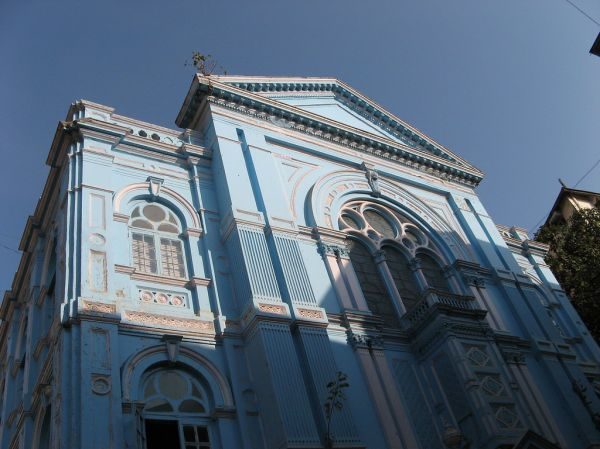
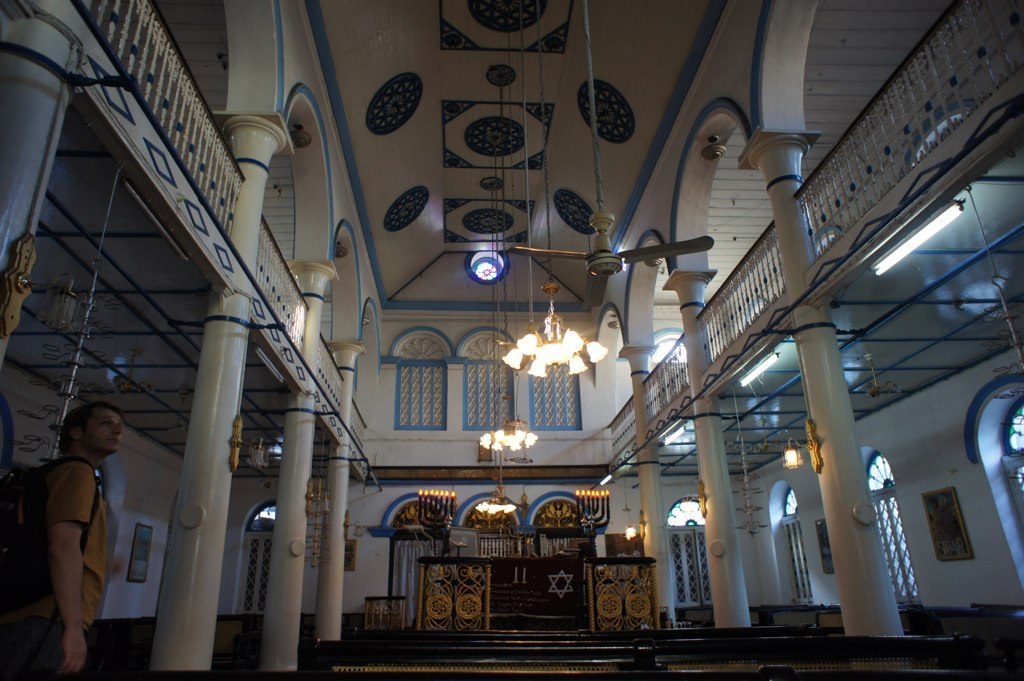
The community's confidence is written in brick. Neveh Shalome, the oldest of the surviving synagogues, went up in 1825; Beth El followed in 1856, rebuilt and enlarged in 1886 by Elias Shalom Gubbay. Then, in 1884, came the building everyone remembers. Elias David Ezra raised the Magen David Synagogue in memory of his father, David Joseph Ezra, in a confident Italianate style with a tall steeple over the commercial quarter - large enough that visitors called it one of the great synagogues of the East. The Ezras were not only worshippers in nineteenth-century Calcutta. They were among its builders, leaving Victorian facades across the city.
Around the synagogues grew the apparatus of a real community: the Jewish Girls' School, founded in 1881; the Elias Meyer Free School and Talmud Torah for the sons of poorer families; a benevolent association; and, from 1902, a bakery called Nahoum & Sons in the New Market, whose fruit cake and cheese samosas became a Calcutta institution far beyond the community that made them. Nahoum's is still there. It is, by most reckonings, the last Jewish-owned business in the city.
Shalom Cohen reaches Calcutta
Shalom Obadiah ha-Cohen, a jeweller born in Aleppo in 1762, settled in Calcutta in 1798 and traded in jewels and precious stones, later serving as court jeweller at Lucknow. His son-in-law Moses Dwek Cohen and the merchant Joseph Ezra put the community on a firm footing, after which Baghdadi arrivals - many fleeing the rule of Dawud Pasha of Baghdad - came to dominate it.
Jewish Virtual Library, "Calcutta"Citizens of the port
Being Baghdadi in Calcutta did not mean keeping the city at arm's length. It meant entering it. David Joseph Ezra, who died in 1882, was both a leading merchant and one of the developers behind much of Victorian Calcutta. His grandson, Sir David Elias Ezra, served as Sheriff of Calcutta, sat on the board of the Reserve Bank of India, and was knighted by King George V in 1927. The community supplied lawyers, doctors, soldiers and civil servants, and it did so without ceasing to be itself. Synagogue and stock exchange were a short walk apart, and people kept both appointments.
It even reached the screen. Esther Victoria Abraham, a Calcutta Baghdadi who took the stage name Pramila, won the first Miss India contest in 1947 and went on to become one of the earliest women film producers in the Hindi industry. A community of a few thousand had produced a printer, a knight, a bank director and a beauty queen who made films. That is not survival. That is participation.
The Magen David Synagogue
Elias David Ezra built the Magen David Synagogue in 1884 in memory of his father, David Joseph Ezra. Designed in an Italianate manner with a tall steeple, it was among the largest synagogues in the East and shared a compound with the older Neveh Shalome. Restored over 2015-2017, it was re-dedicated, together with Beth El, in December 2017.
Magen David Synagogue, Kolkata - protected monumentA community of a few thousand owned printing presses, schools and three great synagogues. That is not small. That is dense.
The thinning
Then the city emptied of them. Indian independence in 1947 and the founding of Israel in 1948 set the community moving - to Israel, to Britain, to Australia - and the numbers fell with startling speed. From a few thousand at mid-century, Calcutta's Jews were down to perhaps 1,500 by 1951, around 700 by the end of the 1960s, a couple of hundred by the 1990s, and at last to a handful of mostly elderly residents. The schools the community had founded kept teaching, but the pupils were no longer Jewish.
What remains is unusually solid for so small a remnant. The three synagogues stand, protected and restored. The bakery still trades. And the buildings are not relics behind glass; they are public, walked past and worshipped in on the high holidays when there is a minyan to be gathered. The Baghdadis came to Calcutta to do business and stayed to make a home. The home outlasted almost everyone who lived in it, which is one definition of having built it well.
Further reading