Most diaspora portraits begin with a graveyard older than the country around it. Beijing's begins with a flight landing. There is no medieval quarter here, no Ladino street names, no synagogue with three centuries of soot on its ceiling. What there is, in the capital of the world's most populous state, is a living Jewish presence assembled almost entirely in the last few decades out of diplomats, traders, students and the rabbis who follow them. It is young, mobile and small. It is also unmistakably there.
China does hold an old Jewish story, but it is not Beijing's. That belongs to Kaifeng, the Henan city where Jews settled more than a thousand years ago and where Matteo Ricci, sitting in Beijing in 1605, first learned from a visiting Chinese official that the thing existed at all. Beijing's chapter is the opposite kind: not deep roots but fresh arrivals, the Jewish life that travels with passports and postings rather than the Jewish life that stays put for forty generations.
A community made of arrivals
The hinge year is 1992, when China and Israel established full diplomatic relations and Israel opened its embassy in the capital. That single act of statecraft did more than exchange ambassadors. It gave the loose scatter of Jews already passing through Beijing a fixed point to gather around. That very year the lay congregation Kehillat Beijing held a joint Passover seder with the new embassy, a small scene that says a good deal: a community and a state, both freshly arrived, keeping the festival of leaving Egypt together in a Chinese hotel.
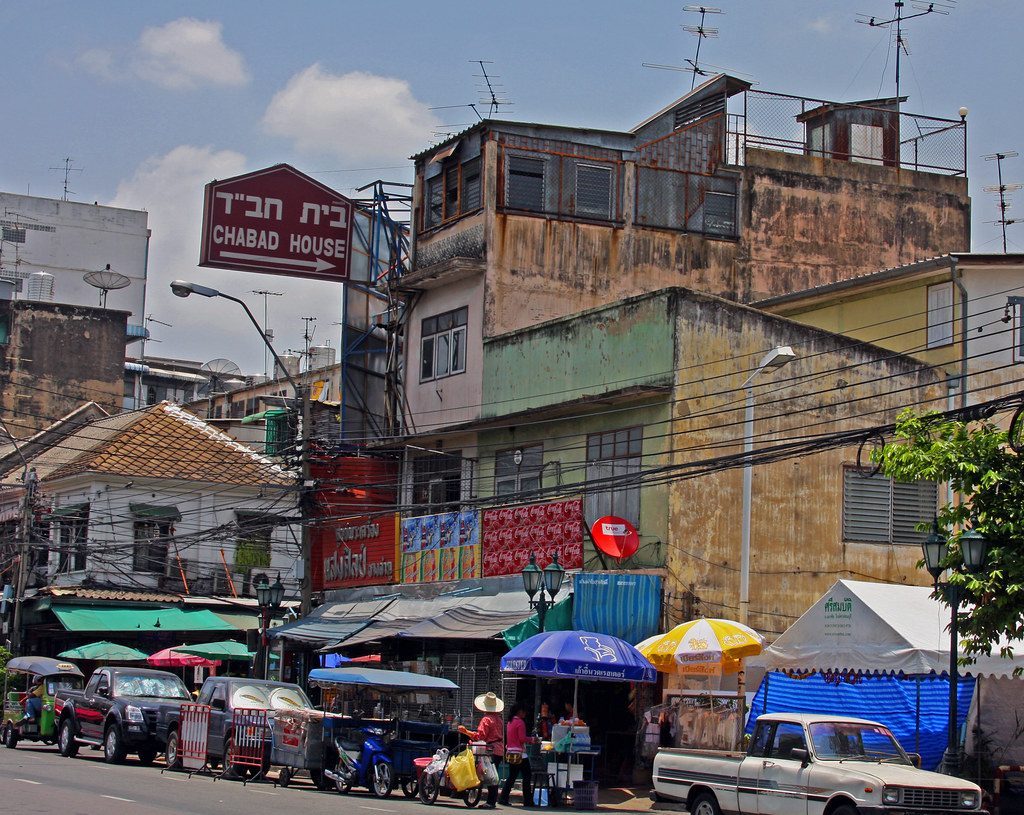
From there the usual modern machinery appeared. Chabad-Lubavitch emissaries set up across China, running centres that keep kosher kitchens, hold services and look after travellers far from home. Reform and lay congregations meet too. None of this rests on inherited buildings or ancestral plots. It rests on people who chose to be here this year, and on the institutions agile enough to serve people who might be gone the next. That is a real community. It is simply a community built forward rather than inherited backward.
Diplomatic relations, and an embassy
The People's Republic of China and Israel established full diplomatic relations on 24 January 1992, and Israel opened its embassy in Beijing the same year. The tie anchored the capital's organised Jewish life: in 1992 the lay congregation Kehillat Beijing marked Passover with a joint seder alongside the embassy.
Israel Ministry of Foreign Affairs · Kehillat BeijingHow many, and how long
Numbers for a transient community are slippery by nature, and honesty about that is part of the stone register here. Estimates of the expatriate Jewish population of Beijing have run to roughly a thousand or more in recent years, set against perhaps a thousand in Shanghai and several thousand in Hong Kong. These are counts of residents who turn over: a posting ends, a contract closes, a family moves on, and the figure resets. The community persists; its individual members rotate through it like water through a riverbed.
Out of that churn come moments worth keeping. The embassy has held public Hanukkah events in the city, including a candle-lighting staged at the Great Wall, the menorah set against a monument built to keep outsiders out. There is a good Jewish joke buried in that image, and no need to dig it up. The point stands on its own: a festival about a light that should have gone out and didn't, lit on the most famous wall on earth, by a people who have outlasted a fair number of walls.
Some Jewish places are inherited and some are assembled. Beijing is assembled, freshly, every year, and the candles still get lit.
China's deep-rooted community was elsewhere
The historic Jewish community of China was at Kaifeng in Henan, established by around the eleventh century and the only long-rooted, native Jewish community in the country. European awareness of it dates to 1605, when a Kaifeng Jew called on the Jesuit Matteo Ricci in Beijing. Beijing's own Jewish presence is, by contrast, a modern expatriate formation rather than a continuous old community.
Jewish Virtual Library · History of the Jews in ChinaWhat Beijing keeps
What the capital keeps is not a relic but a habit: the habit of being Jewish wherever the work takes you, with whoever else turned up, on the dates the calendar insists on. It is the diaspora in its most mobile, contemporary form, the same instinct that carried Baghdadi merchants to Shanghai a century earlier now carrying engineers and diplomats to Beijing. The story is thin in years and real in practice. On the map of the Jewish world it earns a small, bright, honest mark.
Further reading