There is a narrow lane in Frankfurt that taught the modern world more than it ever meant to. The Judengasse was barely four metres wide, gated and locked at night, and into it the city pressed its entire Jewish population for nearly three and a half centuries. From that confinement came a banking dynasty that financed empires, a school of Orthodoxy that argued with modernity rather than fleeing it, and a community that, at its height, made up one in sixteen of the whole city. Frankfurt did not merely tolerate its Jews. For a long stretch of European history, it was partly built by them.
Jews appear in the Frankfurt record as early as 1074, when Henry IV granted privileges to the city's burghers and Jews alike, and a community is named by the mid-twelfth century. Then comes the first of the catastrophes that punctuate this story without ever ending it: in 1241 a mob fell on the quarter and killed roughly 180 people, a number the city's own museum still records. The community reformed. It always did. That is the rhythm of Frankfurt - breaking, then rebuilding, then breaking again, and each time the page survives the fire.
The lane and the dynasty
The Judengasse opened in 1462, when Emperor Frederick III ordered the Jews out of the city proper and into a single curving alley built against the wall. It was meant as a humiliation and a cage. What grew inside it was a self-governing world: synagogues, a court, schools, a bathhouse, a density of life that by the early seventeenth century had crammed nearly three thousand people into fewer than two hundred houses. It burned to the ground in 1711 in a single day, and was rebuilt. It was emptied by riot in 1614 and refilled by imperial decree two years later. The lane absorbed everything Europe threw at it and kept its address.
The most famous house in the lane bore a red shield. From it the Rothschilds took their name, and from the cramped premises of the Judengasse, Mayer Amschel Rothschild, born there in 1744, built the foundations of a bank that would shortly be lending to the governments of Europe. It is worth sitting with the geography of that. The family that bankrolled empires began in an alley those empires had built to keep Jews out of sight. Confinement, it turns out, is not the same as containment.
The ghetto's walls came down for good in 1811, when the community paid 440,000 florins for the equal civil rights that should never have carried a price. Emancipation, when it arrived, found Frankfurt's Jews ready. They had been running a complete civilisation in a space the width of a corridor.
The community's first centuries
Henry IV's charter of 1074 names Jews among the privileged inhabitants of several Rhineland towns including Frankfurt, and a settled community is attested by the mid-twelfth century. In May 1241 a violent assault on the quarter killed about 180 Jews, with a small number surviving through forced baptism. The community was reconstituted in the decades that followed.
Jewish Museum Frankfurt; Encyclopaedia JudaicaReform, Orthodoxy and a city of scholars
By the sixteenth and seventeenth centuries Frankfurt was one of the leading Jewish communities of the Holy Roman Empire, and its yeshivot drew students from across the continent. Isaiah Horowitz held the rabbinate here in the early seventeenth century; the talmudist Meir Schiff, the Maharam Schiff, was a Frankfurt man. The lane that the city built to diminish its Jews became instead one of the addresses serious Jewish learning could not ignore.
In the nineteenth century, free of the walls at last, the community split into the two great modern arguments and hosted them both. The Philanthropin, founded in 1804 with Rothschild backing, became a flagship of reforming, German-speaking Jewish education. Against it stood Samson Raphael Hirsch, who from 1851 led the separatist Israelitische Religionsgesellschaft and built the intellectual case for an Orthodoxy that engaged the modern world rather than retreating from it - Torah im Derech Eretz, Torah together with the way of the land. Frankfurt is one of the few places that can claim to be a birthplace of both modern Reform and modern Orthodoxy, which tells you something about its size and its appetite for a good argument.
The same soil grew thinkers the city would later try to disown. Anne Frank was born in Frankfurt in 1929; her family left for Amsterdam within a few years. The Institute for Social Research, the Frankfurt School of Horkheimer and Adorno, took shape here in 1923 before the Nazis scattered it into exile. The city poured out talent and then, in the worst decade, poured out its people.
The Westend Synagogue
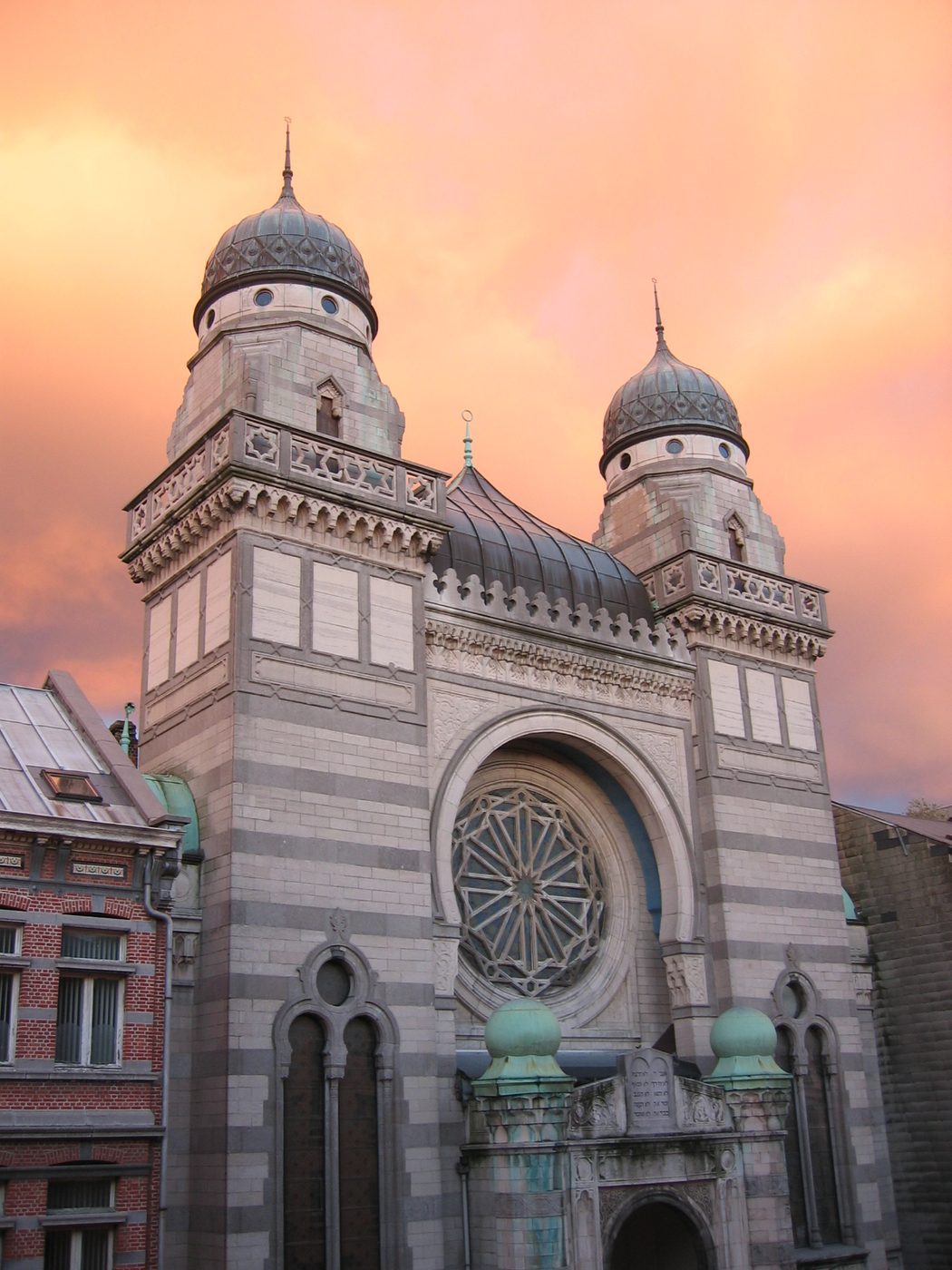
Built between 1908 and 1910 to the design of Franz Roeckle, the Westend Synagogue was the largest in Frankfurt. It was the only one of the city's four great pre-war synagogues to survive the November pogrom of 1938 and the wartime bombing, damaged but standing. Reconstructed after the war, it was reconsecrated in 1950 and remains the spiritual centre of the community.
Westend Synagogue; Jewish Museum FrankfurtThe break and the return
At its peak, in 1925, Frankfurt counted some 29,000 Jews, about 6.3 per cent of the city - the highest Jewish share of any German city. Then came the deportations. The first transport left in October 1941; by 1943 only a few hundred Jews remained where there had been thirty thousand. The community that had survived 1241, survived 1614, survived the fire of 1711, was very nearly erased inside a single decade. It would be dishonest to write Frankfurt without that sentence sitting heavily in the middle of it.
And yet. After the war a community reassembled from the handful who remained and the survivors who came back, and it grew. Today Frankfurt's Jewish community numbers around seven thousand, among the largest in Germany, a great many of them arrivals from the former Soviet Union who chose this city of all cities to begin again. That choice is its own kind of statement.
The family that bankrolled empires began in an alley those empires built to keep Jews out of sight. Confinement was never the same as containment.
What the river city keeps
Frankfurt is a city that knows the difference between rebuilding and replacement, because it has done the harder of the two. The Judengasse is a museum now, its foundations under glass. The Westend Synagogue still fills on a Friday night. The community is smaller than it was and entirely alive, which is the only condition that has ever mattered. The lane is closed. The page is open.
Further reading