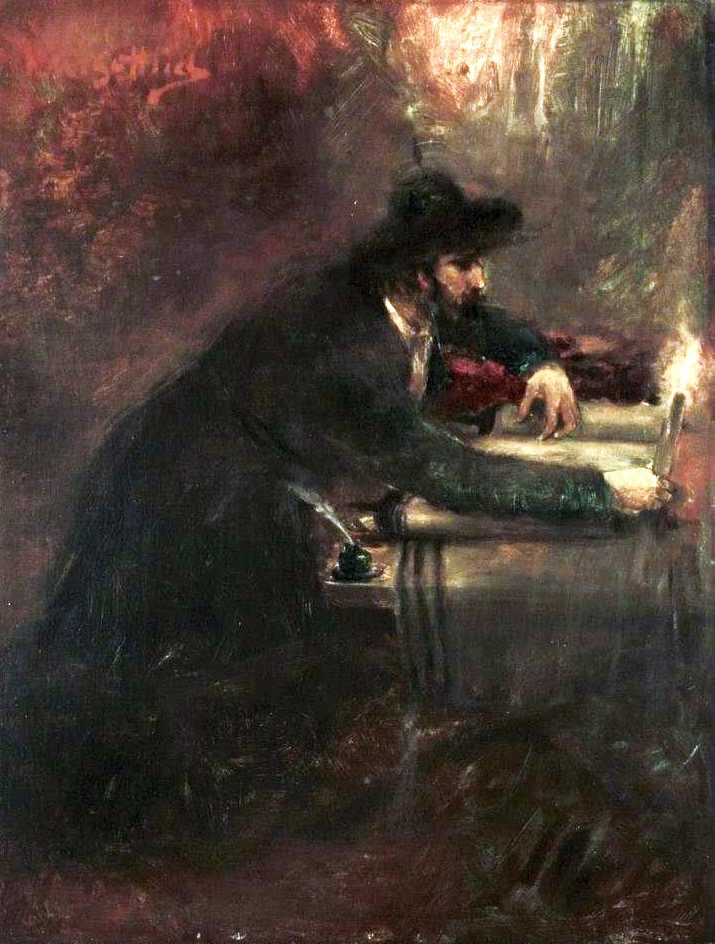
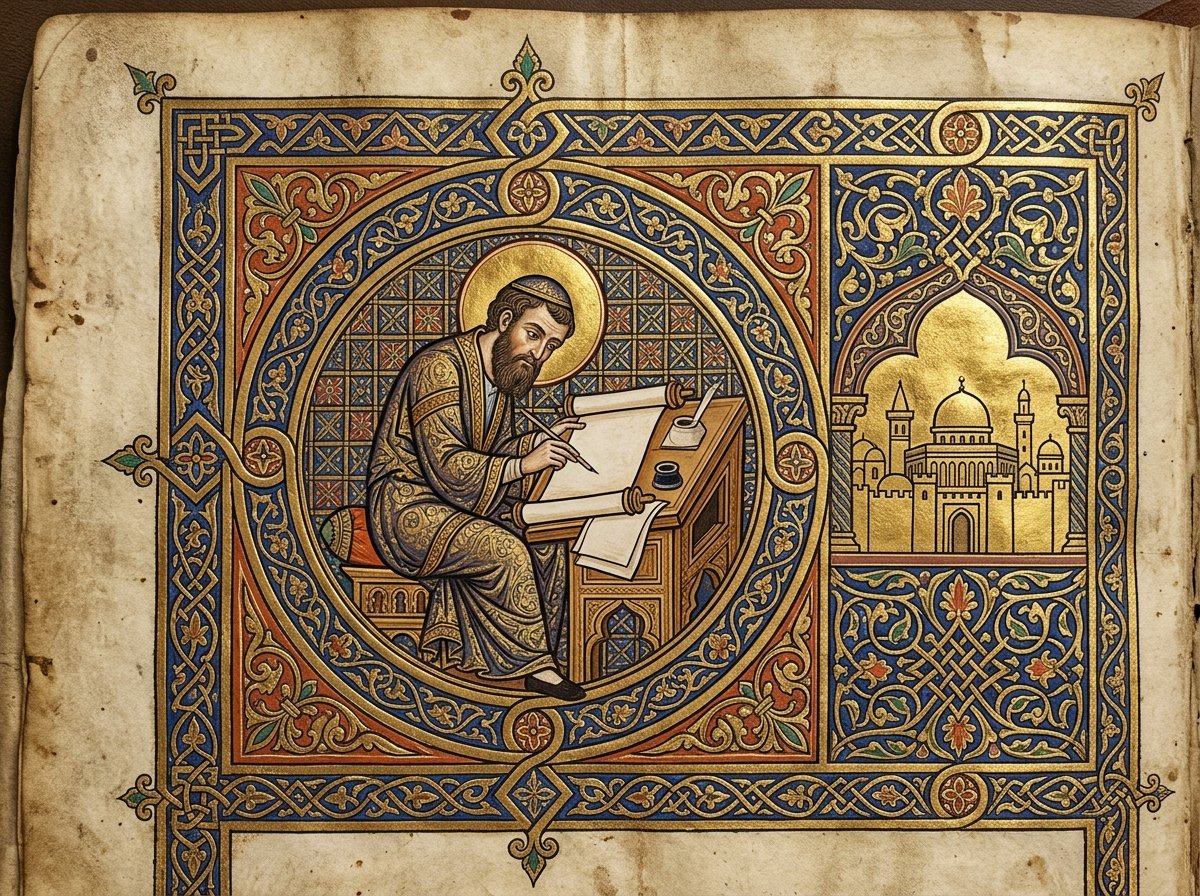
There was a community living here, on the limestone shelf above the north-west shore of the Dead Sea, probably from around 150 BCE. They built a settlement - Khirbet Qumran - with a scriptorium, a dining hall, ritual baths and a cemetery. They read. They copied. They argued theology with a fierceness that produced some of the most unusual Jewish writing of the Second Temple period. And at some point, before the Roman Tenth Legion marched south to crush the Jewish revolt in 68 CE, they packed up their library - hundreds of manuscripts in clay jars - and carried the jars up into the limestone cliffs above their settlement, and hid them in eleven different caves.
Then they were gone. The library waited in the dark for nineteen centuries, perfectly dry, perfectly sealed. The jars held. The desert held. The text held. When a Bedouin shepherd named Muhammed edh-Dhib stumbled into Cave 1 in early 1947, he found not one scroll but seven - and the systematic searches that followed turned up nearly nine hundred manuscripts in total, most of them in fragments, but together constituting the largest cache of ancient Jewish texts ever found. The Qumran library is not a single scroll. It is a whole world of reading, compressed into jars and hidden in the rock.
The record
Between 1947 and 1956, eleven caves at Qumran yielded approximately 981 manuscripts, now conventionally described as 972 distinct texts, representing nearly every book of the Hebrew Bible as well as previously unknown sectarian writings, legal codes, hymns, and apocalyptic visions. Cave 4 - a rock-cut chamber discovered in 1952 - contained the largest single deposit: fragments of around 575 manuscripts, accounting for the majority of the whole find. The scrolls are dated by radiocarbon analysis and palaeographic study to between approximately 250 BCE and 68 CE. Editions of the full corpus are published in the Discoveries in the Judaean Desert series (Oxford University Press, 54 volumes, 1955-2010).
What makes the Qumran library remarkable is the range. Any large ancient library will have copies of its scripture - that is expected. What you do not expect is the diversity of everything around the scripture. Among the nearly nine hundred Qumran manuscripts, scholars have identified copies of every book of the Hebrew Bible except Esther. But they have also found entirely new texts: the Community Rule (Serekh ha-Yahad), a handbook of initiation, discipline, and theology for the sect; the War Scroll, an elaborate battle plan for the final eschatological conflict between the Sons of Light and the Sons of Darkness; the Temple Scroll, the longest of all the Dead Sea Scrolls at nearly nine metres, presenting an alternate version of the Torah's cultic law as if dictated directly; the Hodayot, a collection of thanksgiving hymns that read like psalmody from a new, harder-edged register. And the pesharim - interpretive commentaries on the prophets, reading Habakkuk and Nahum and Isaiah as coded accounts of the sect's own history. These people were not passive readers. They were arguing back.
The manuscripts also include texts that fall between canon and sect: the Book of Jubilees, the Book of Enoch, the Genesis Apocryphon - texts known from other ancient sources but surviving here in their oldest or most complete Hebrew and Aramaic versions. The Qumran library preserves a Jewish literary world from before the canon was fixed, from a moment when the lines between scripture, interpretation, and new composition were still fluid. It shows what a serious Jewish community was actually reading and thinking about around the time the Second Temple still stood.
The record
The Temple Scroll (11Q19), found in Cave 11 and acquired by Israeli archaeologist Yigael Yadin in 1967, measures approximately 8.75 metres - the longest of all the Dead Sea Scrolls. It presents 66 columns of legal material relating to Temple architecture, festivals, and purity regulations, written in the first person as divine speech. Yadin published his critical edition in three volumes (Israel Exploration Society, 1977-1983). The Community Rule (1QS), found in Cave 1 in 1947, is regarded by most scholars as the foundational document of the Qumran sect; it describes a community organised around shared meals, communal property, ritual immersion, and a two-year initiation period. Both manuscripts are held by the Israel Antiquities Authority and displayed at the Shrine of the Book, Israel Museum, Jerusalem.
Who were they? The dominant scholarly view identifies the Qumran community with the Essenes, a Jewish sect described by Josephus, Pliny the Elder, and Philo of Alexandria - ascetic, celibate in at least some branches, contemptuous of the Jerusalem Temple establishment and its priestly compromises. A minority of scholars have pushed back, arguing the scrolls are a library from Jerusalem itself, a diverse collection moved to the desert for safekeeping, not the productions of a single sectarian group. The physical evidence of the settlement - the inkwells, the long tables, the cylindrical jars matching the scroll jars - supports the idea of a scribal community working on site. But the argument continues, which is entirely fitting for a body of texts this rich. The library does not resolve itself easily. It keeps asking questions.
The record
Pliny the Elder, writing in his Natural History (Book V, 17) around 77 CE, describes a community of Essenes living above the western shore of the Dead Sea, west of the salt, away from women and money - a description that fits the Qumran location. Flavius Josephus devotes substantial passages in The Jewish War (Book II, 8) and Antiquities of the Jews (Book XIII, 5) to the Essenes, describing their communal property, ritual purity practices, and apocalyptic expectation. Both accounts pre-date the major scroll publications and were written independently; the alignment between their descriptions and the Community Rule found at Qumran remains the strongest argument for the Essene identification.
The caves above Qumran held not a relic but a reading life - the full intellectual and spiritual range of a Jewish community living under Roman occupation, waiting for an end-time they believed was close. That community was destroyed. The settlement was burnt. The men who filled those jars did not come back. But the library they hid was patient in a way that human plans never are. It waited for the right question, and the question arrived, carried by a shepherd looking for a goat. What came out of the jars was not just text. It was the evidence that the tribe had always been a people of argument, of study, of restless interpretation - and that even under the worst pressure, their first instinct was to save the books.