Before the scribe, the priest. For most of Israel's early history the Torah - the teaching - was guarded by priestly families who read it at festivals and interpreted it for kings and courts. Ordinary Israelites encountered the text at a distance, through ceremony and through whatever they could hear from a temple court. The text was real and revered, but it was not yet a thing you could sit down with, study line by line, and then go home and teach your children.
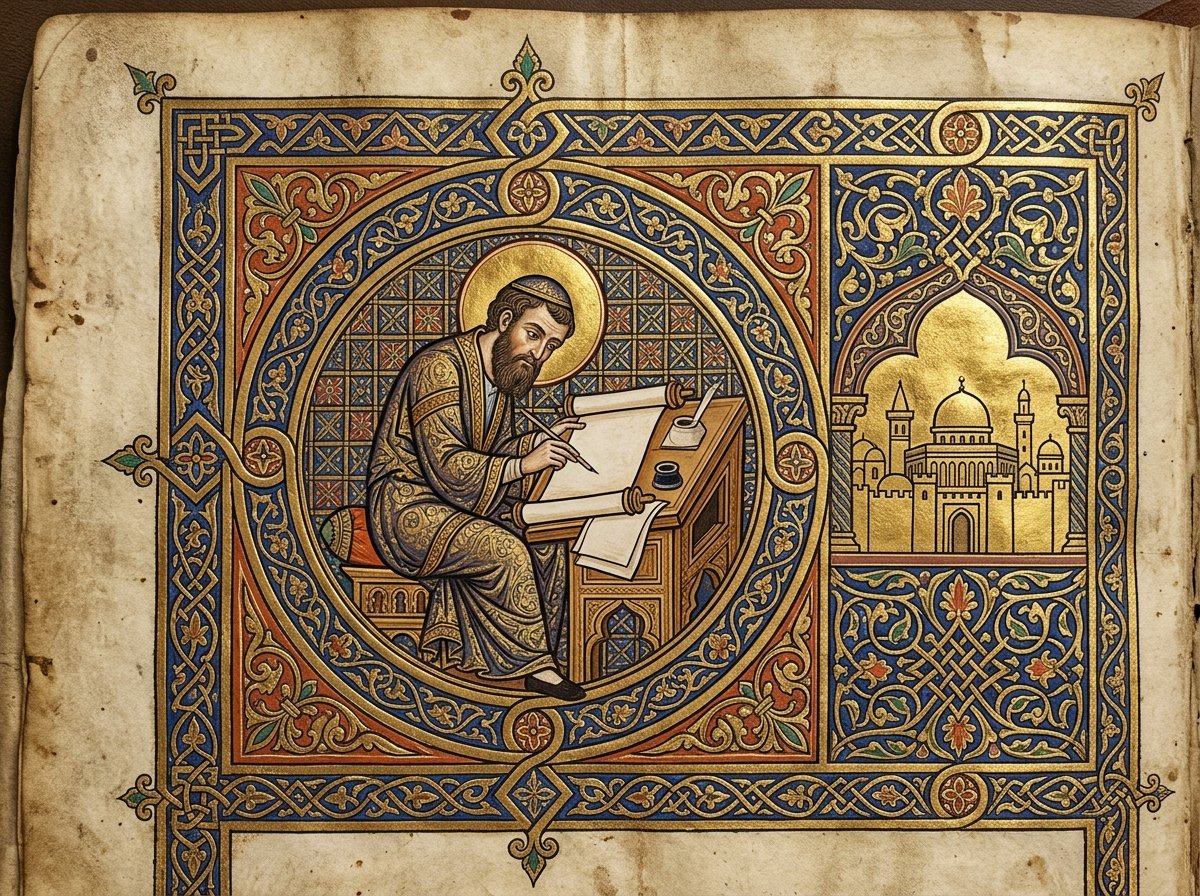
Something shifted in the early Second Temple period. The Babylonian exile had broken the institutional life of Jerusalem - the temple burned, the priesthood scattered, the king dethroned. What survived the exile was carried in memory and in scrolls. When the exiles began returning after 538 BCE, they returned to a land that needed rebuilding from first principles. Into that need stepped a new figure: the sofer, the scribe - a man whose expertise was not the altar but the written word, who could make a scroll, read a scroll, and most importantly, explain what it meant. The text was no longer a priestly secret. It was a national document, and someone had to be its professional guardian.
The record
The book of Ezra-Nehemiah, composed in its present form in the fifth or fourth century BCE, identifies Ezra as "a scribe skilled in the Torah of Moses" (Ezra 7:6) and records that the Persian king Artaxerxes I authorised him to go to Jerusalem "to inquire about Judah and Jerusalem according to the Torah of your God, which is in your hand" (Ezra 7:14). The passage - known to scholars as the "Ezra memoir" - presents the scribal role as a recognised Persian administrative function as well as a Jewish religious one. The dual standing was not accidental: Persian imperial policy encouraged local legal experts to codify and apply native law within their province. Ezra's commission fits a pattern attested in Egyptian and Babylonian contexts of the same era, documented in the work of biblical scholar Joseph Blenkinsopp (Ezra-Nehemiah: A Commentary, Westminster John Knox Press, 1988).
The scene described in Nehemiah chapter 8 is one of the most remarkable in the Hebrew Bible. Ezra stands on a wooden platform in the open square before the Water Gate. He opens the scroll in the sight of all the people. They stand. He blesses; they answer Amen. He reads, and the Levites among the crowd move through the assembly explaining the text to those who cannot follow the Hebrew - a detail that has fascinated scholars for centuries, because it implies a reading public already diverse in its grip on the ancestral language, and a cadre of interpreters ready to serve them. This is not the temple cult. This is something new: public, participatory, explanatory. The text is being handed over. The scholar Israel Finkelstein and biblical historian Neil Asher Silberman have called it a founding moment in the "democratisation of the Torah" (The Bible Unearthed, Free Press, 2001). Whether or not Ezra's gathering happened exactly as described, the ideal it encodes - Torah read aloud to everyone, explained to those who need it, available to the whole community - became the engine of Jewish learning for every century that followed.
The record
The title sofer (scribe) as a distinguished professional designation appears in the Hebrew Bible in several late pre-exilic and post-exilic texts. Shaphan the scribe served King Josiah and is credited with bringing the "book of the Torah" found in the temple to the king's attention (2 Kings 22:8-10), an event dated by the biblical text to c. 621 BCE. By the Persian period the sofer's work had expanded well beyond royal administration: the Dead Sea Scrolls, discovered at Qumran between 1947 and 1956 and now largely housed at the Israel Museum in Jerusalem, preserve hundreds of manuscripts produced between roughly 250 BCE and 70 CE by scribal communities who treated the act of copying as a religious discipline in itself. The scrolls show a scribal culture already highly developed, with standardised scripts, correction systems, and an evident programme of preservation - the direct heir of the tradition Ezra's generation established.
What Ezra and his generation did was give the tribe a new kind of home. The land could be taken. The temple could be burned. But a scroll could travel - had already travelled - and a community that knew how to read it, copy it, and argue over it could reconstitute itself anywhere. The scribe was the professional who made that portability possible. The rabbis who would come after the destruction of the Second Temple in 70 CE were the scribes' heirs; the study house was the temple's replacement; the argument over a difficult passage was the sacrifice turned into sound. None of that would have been possible without the man who stepped forward in the fifth century BCE with a scroll under his arm and a readiness to explain.
The tradition that Ezra was the "second Moses" - restoring the Torah to a people who had nearly lost it - is a later rabbinic elaboration, but it points at something true. The scribal revolution of the early Second Temple period did not merely preserve a text; it created a people for whom a text could be home. We have been studying that text, arguing about it, copying it by hand and teaching it to our children, ever since. The scribe who steps forward in Nehemiah 8 is still stepping forward, in schools and study halls and kitchen tables, in every generation.