There is a kind of heroism that leaves no individual names. The great Amoraim - the rabbinic masters whose arguments fill the pages of the Babylonian Talmud - were celebrated in their lifetimes and remembered by name ever after. Rav and Shmuel, Abaye and Rava, Rav Ashi and Ravina: the tradition preserved not just their rulings but their sharpest ripostes, their midnight anxieties, their dreams. These men had been part of an argument alive enough to generate its own heat.
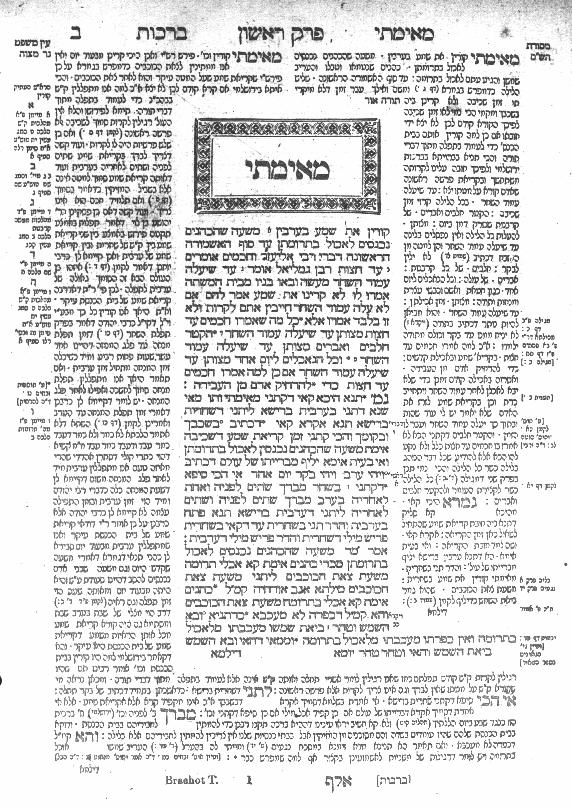
Then around 500 CE the argument was finished. The Amoraim were gone. What remained was a generation of scholars the tradition would call the Savoraim - from the Aramaic root meaning to reason, to consider, to weigh. They did not add new legal arguments in the Amoraic sense. They did something harder to romanticise: they read everything that had been accumulated over three centuries of Babylonian academies, smoothed its rough edges, inserted bridging clauses, standardised anonymous introductory formulae, and made the whole extraordinary structure navigable. They were, in the plainest sense, editors - and the book they closed became the Babylonian Talmud that all subsequent Jewish learning would treat as its sea.
The record
The term Savoraim appears in medieval Jewish chronological literature as a formal designation for the post-Amoraic, pre-Geonic period. The Iggeret Rav Sherira Gaon - a letter written by Sherira, head of the Pumbedita academy, in 987 CE - is the earliest systematic account of the chain of Talmudic transmission and explicitly names the Savoraim as a distinct generation following the Amoraim. Sherira Gaon places their activity between approximately 500 CE and the opening of the Geonic era in the mid-seventh century. The Iggeret is preserved in two manuscript versions (the French and Spanish recensions) and is the primary source for the chronology of Talmudic transmission. Translated and analysed by Robert Brody in The Geonim of Babylonia and the Shaping of Medieval Jewish Culture (Yale University Press, 1998).
To call the Savoraim editors is not to diminish them. The Babylonian Talmud as it reached the academies of the early Geonic period was not a tidy object. It was the residue of oral teaching transmitted across generations of Babylonian academies - primarily at Sura and Pumbedita - where masters had argued, disciples had recorded, and successive generations had added layer upon layer. The Savoraim's contribution was to impose shape without suppressing the argument. They kept the back-and-forth, the unresolved questions, the minority opinions, the traditions that contradicted each other and were allowed to stand in contradiction. What they added was the connective tissue - the transitional phrases, the opening gambits, the small grammatical hinges that let a reader follow the thread of a discussion across centuries of accumulated opinion. They also, according to later Geonic testimony, introduced certain clarifications and minor additions to ease understanding. The result was not a code. It was a world - and the Tribe would live in it.
The record
The two great Babylonian academies associated with Talmudic compilation - Sura and Pumbedita - are attested in Talmudic literature itself and in later Geonic sources. Rav Ashi (c. 352-427 CE) and his colleague Ravina II (died c. 499 CE) are traditionally identified in the Iggeret Rav Sherira Gaon as the last of the Amoraim and the figures who brought the major Amoraic stratum of the Talmud to a close. The phrase "the end of hora'ah (authoritative legal decision)" is associated with Ravina's death in Talmudic tradition (Bava Metzia 86a). The Savoraic additions and editorial activity are discussed in detail by David Weiss Halivni in Mekorot U-Mesorot (Sources and Traditions), an ongoing multi-volume critical commentary on the Babylonian Talmud, and in his essay "The Reception Accorded to Rabbi Judah's Mishnah" in Jewish and Christian Self-Definition, vol. 2 (ed. E. P. Sanders, Fortress Press, 1981).
The Savoraim worked in Babylonia under Sassanid Persian rule and, towards the end of their period, under the upheaval of the early Islamic conquests. They were not sealing a finished monument in a time of calm. They were consolidating a tradition under external pressure, in academies whose physical continuity was not guaranteed. That they produced a document stable enough to be copied and carried to North Africa, Spain, France, the Rhine Valley, and eventually the entire Jewish world, is itself the measure of what the reasoning cost. They remain largely nameless. The book they handed forward is not.