By the rivers of Babylon they sat down and wept. That much is in the psalm, and it is true. But the psalm doesn't say what happened next. What happened next was that they put the harps back up, organised themselves into communities, negotiated with their captors, argued about the Law, taught their children, bought land, planted gardens, built houses, and - within two generations - produced some of the most fertile Jewish intellectual life the world had seen. The weeping was real. So was everything that followed.
When Nebuchadnezzar destroyed Jerusalem in 586 BCE and marched the leadership of Judah to Babylon, he was applying a well-tested Assyrian technique: remove a people from its land, scatter its elite, wait for the community to dissolve into the larger population. The technique had worked on the northern kingdom of Israel a century and a half earlier - those ten tribes are called "lost" for a reason. With Judah it failed, and the failure is one of the more consequential accidents in human history. The exiles didn't dissolve. They organised.
The record
The Murasu archive - a collection of some 730 cuneiform tablets excavated at Nippur in the 1890s, now held at the University of Pennsylvania Museum of Archaeology and Anthropology and the Istanbul Archaeological Museums - dates to 454-404 BCE and records the business dealings of a Babylonian banking family. Jewish names appear throughout: clients, creditors, landowners, and officials bearing Hebrew names in Babylonian transliteration, including forms of Gedaliah, Hananiah, and Shabbetai. The archive demonstrates that within a century of the exile, Jewish families were integrated into the Babylonian agricultural and commercial economy, holding land leases and operating credit arrangements with non-Jewish neighbours. (Matthew W. Stolper, Entrepreneurs and Empire, Leiden 1985.)
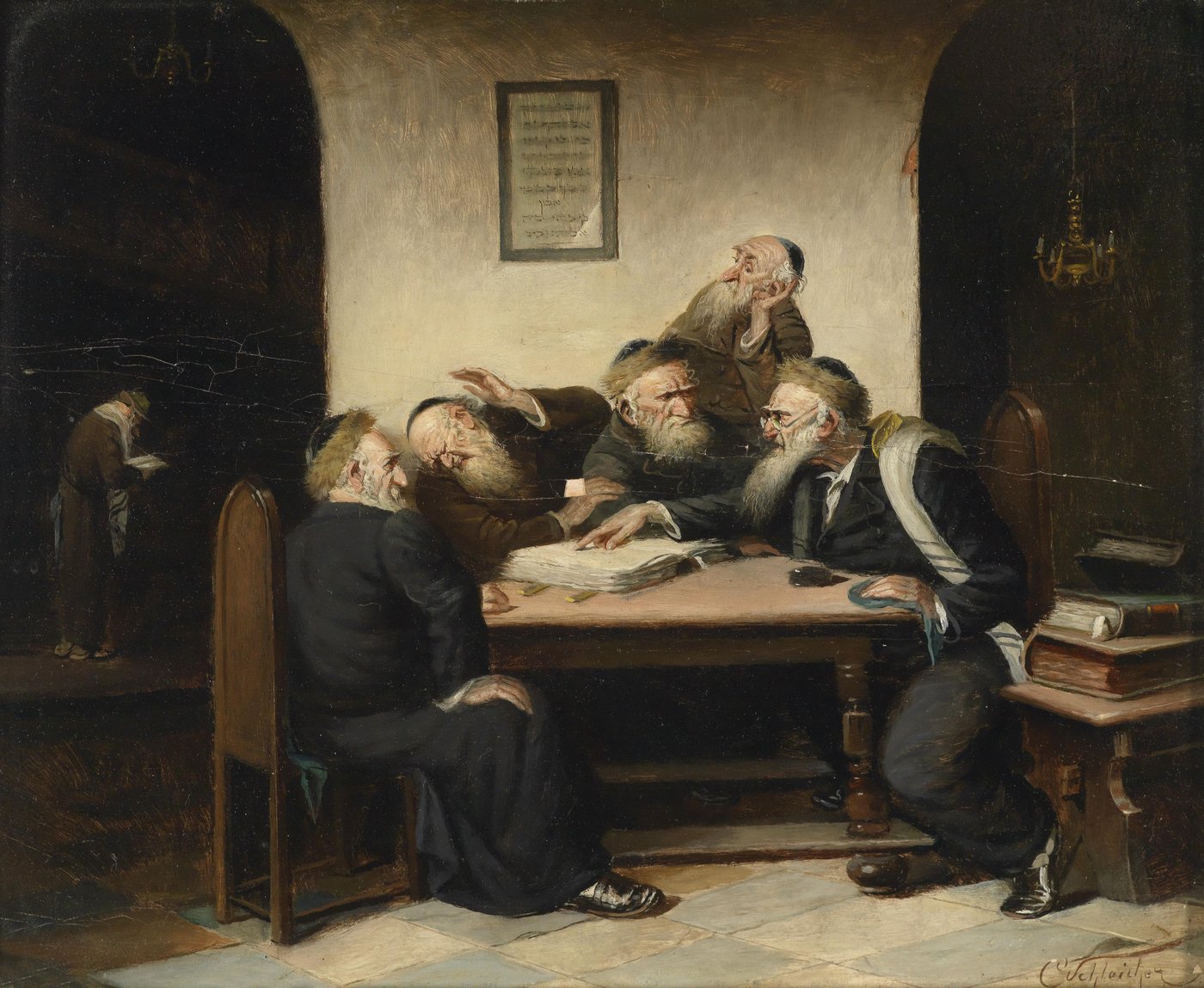
The exiles' great discovery - worked out under duress, over decades - was that Jewish life did not require a Temple. It required a community, a text, and a habit of gathering to study both. In Babylonia, the synagogue took on its enduring rabbinic form: not a sacrifice-house but an assembly house, where the scrolls were read aloud and the Law was argued through. This was a radical reinvention dressed as continuity, and it worked because the teachers were good and the students understood what was at stake. When Cyrus of Persia conquered Babylon in 539 BCE and told the exiles they could go home, a significant number went. But a significant number also stayed. Babylon, for them, had become home.
The record
The two great Babylonian academies - at Sura, founded by Rav (Abba bar Aivu) around 219 CE, and at Pumbedita, founded by Judah bar Ezekiel around 259 CE - operated for roughly eight centuries and produced the Babylonian Talmud: thirty-seven tractates of legal analysis, narrative, medicine, folklore, and argument that remain the central text of rabbinic Judaism. The Talmud Bavli was sealed in its final redacted form around 500-600 CE and has been studied continuously since. The academies themselves persisted under the Gaonic period into the eleventh century, producing the authoritative legal rulings - responsa - that guided Jewish communities from Spain to Persia. (Robert Brody, The Geonim of Babylonia and the Shaping of Medieval Jewish Culture, Yale University Press, 1998.)
The Babylonian Jewish community at its height - through the Parthian and Sassanid periods, roughly 200 BCE to 640 CE - was the largest and most intellectually productive in the world. The Exilarch, the Resh Galuta, held a recognised position at the Persian court: head of the Jewish people in exile, claiming descent from the house of David, presiding over a community that numbered in the hundreds of thousands. When the Islamic conquest arrived in the 630s, the community adapted again - negotiating their status, continuing the academies, sending responsa to Jewish communities across the new Islamic world. The Gaonim of Sura and Pumbedita answered legal questions from Kairouan to Khorasan. The exile had become an empire of a different kind: an empire of correspondence, of text, of portable authority that required no army and no fixed address.
The record
The Cairo Geniza - a repository of discarded documents discovered in the Ben Ezra Synagogue, Fustat (Old Cairo), and first systematically studied by Solomon Schechter of Cambridge in 1896-1897 - contains thousands of letters addressed to the Babylonian Gaonate, including fee payments, legal queries, and community disputes from across the Jewish Mediterranean and Middle East. The Geniza documents, now distributed between Cambridge University Library, the Jewish Theological Seminary of America, and other collections, confirm the reach and authority of the Babylonian academies well into the eleventh century. The Gaonate of Sura formally dissolved around 1034 CE, that of Pumbedita around 1040 CE - not through persecution but through the gradual migration of scholarship to new centres in North Africa and Spain. (S. D. Goitein, A Mediterranean Society, 6 vols., University of California Press, 1967-1993.)
Nebuchadnezzar intended to end Judah. What he actually did was force it to discover that it could live anywhere - in Nippur or Pumbedita or eventually in Cordoba or Vilna or Brooklyn - as long as there was a quorum to study and a book to study from. The exile lasted, in one form or another, for sixteen centuries. In that time the community built the intellectual architecture that every subsequent generation of Jews inherited. The ruin was real. So was everything built in it.