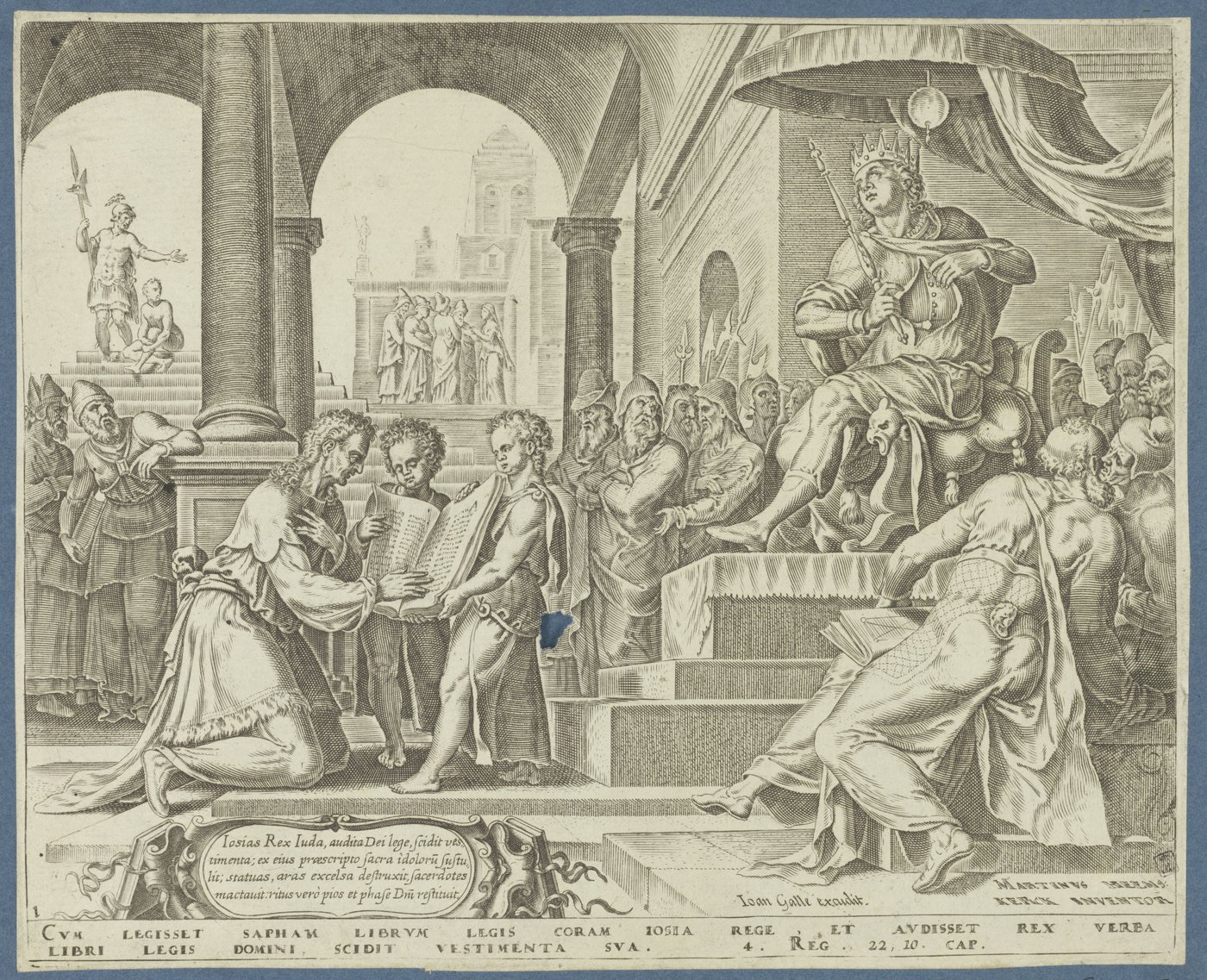
Somewhere in the Temple in Jerusalem, during repairs ordered by King Josiah in the eighteenth year of his reign, a scroll turned up. We do not know exactly where it had been sitting - tucked in a storeroom, folded inside a wall cavity, lost in the upheaval of the decades of idolatry under Manasseh and Amon. The high priest Hilkiah found it and sent it to the royal secretary Shaphan, who carried it to the king and read it aloud. Josiah, hearing its words, tore his robes. The record implies that what he heard was not unfamiliar doctrine but a verdict already arrived at: his kingdom stood under terms that had not been kept.
The king's response was not paralysis but movement. He sent to the prophetess Huldah, who confirmed that the judgement in the scroll was real but that Josiah's own heart - responsive, broken, tender before what he heard - meant he would not see the catastrophe in his lifetime. That combination of diagnosis and reprieve gave Josiah a specific kind of task: to live as though it mattered, knowing the reckoning would fall on those who came after. He gathered the elders of Judah and Jerusalem, stood at the Temple pillar where kings stood, and read the whole scroll to the assembled people. They all committed themselves to the covenant. Then he purged the land - smashed altars on the high places, burned the Asherah poles, defiled Topheth where children had been passed through fire, tore down the horses dedicated to the sun that had stood at the Temple entrance. And when all of that was done, he called Passover.
The record
Second Kings 23:21-23 records Josiah's command: "Keep the Passover to the Lord your God, as it is written in this Book of the Covenant." The text then offers an extraordinary comparison: "No such Passover had been kept since the days of the judges who judged Israel, nor during all the days of the kings of Israel or of the kings of Judah." Second Chronicles 35:1-19 gives far more detail - the organisation of the priests and Levites by their divisions, the quantities of animals provided (thirty thousand lambs and young goats, plus three thousand cattle from the king's own possessions), and the precise choreography of the service, in which the Levites slaughtered on behalf of the assembled worshippers who had come up from the whole of Judah and from "all Israel" - that is, from across the territories of the former northern kingdom as well. The date is the fourteenth day of the first month - the canonical Passover date established in Exodus 12 - and the year is the eighteenth year of Josiah's reign, conventionally dated to 621 BCE. (2 Kings 23; 2 Chronicles 35; the Hebrew Bible; dating follows the standard chronology in John Bright, A History of Israel, Westminster John Knox Press, 4th ed. 2000.)
What made this Passover different was not the feast itself - Passover had been kept in various ways through the monarchy - but the context in which it was now set. It came at the end of a purge, not the beginning. The people who sat down to eat had spent weeks watching the king and the Levites tear out everything that had crept into the worship of the Temple over a generation of royal apostasy. The scroll that had prompted it all was almost certainly the book that scholars now call Deuteronomy, or a substantial portion of it - the book that frames the whole relationship between Israel and its God as a legal treaty, a covenant with terms and consequences. The Passover was the positive enactment of all that the purge had been clearing space for: this is who we are, and we are here together, and we remember the night we became a people. It was the first Passover most of the people in that courtyard had ever attended with any sense that the Temple behind them was uncontaminated.
The record
The scroll found in the Temple - referred to in 2 Kings 22:8 as the "Book of the Law" (sefer ha-torah) - has been identified by the majority of critical scholars since Wilhelm de Wette's 1805 dissertation as the core of what is now Deuteronomy, on the grounds that Deuteronomy contains legislation directly matching Josiah's reforms: centralisation of sacrifice to a single sanctuary (Deuteronomy 12), abolition of the high places, destruction of Asherah poles, and the Passover-at-the-central-sanctuary requirement (Deuteronomy 16:1-8). The Deuteronomic Passover differs notably from the Exodus 12 version: in Exodus 12 it is a household meal with the blood on the doorposts; Deuteronomy 16 requires the animal to be slaughtered "at the place the Lord your God will choose" - that is, at Jerusalem - and the meat roasted and eaten there. Josiah's Passover, performed by the Levites in the Temple courts on behalf of the assembled nation, follows this centralised model exactly. (W. M. L. de Wette, Dissertatio Critica, 1805; Moshe Weinfeld, Deuteronomy and the Deuteronomic School, Oxford University Press, 1972.)
Josiah's Passover is not the first Passover - that was in Egypt, on the night of the tenth plague, with blood on lintels and sandals already on feet. It is not the seder as we now know it - the rabbinic Passover liturgy that crystallised after the Temple's destruction, designed to be performed at home precisely because Jerusalem was gone. Josiah's feast sits between those two: a national convocation at the place that stood for the whole people's centre, called by a king who had just heard what the covenant required and understood that there was almost no time left. There is something clarifying about the way it happened - not gradually, not incrementally, but all at once, in the eighteenth year, because a scroll fell out of the wall and a king listened to it. The Passover Israel kept that spring was as much a statement of intention as a commemoration of the past. They knew what Egypt had been. They were deciding what they would be now.
Josiah died thirteen years later at Megiddo, fighting the Egyptian army of Pharaoh Necho. He did not see the Babylonian destruction of Jerusalem that Huldah had foretold. What he left behind was a Passover the tradition remembered as singular - not because Passover itself was new, but because it had been kept that year by people who had heard the terms of their own covenant read aloud and had chosen, in full knowledge, to renew them. The meal is always in some sense that: a deliberate act of memory by people who know the stakes.