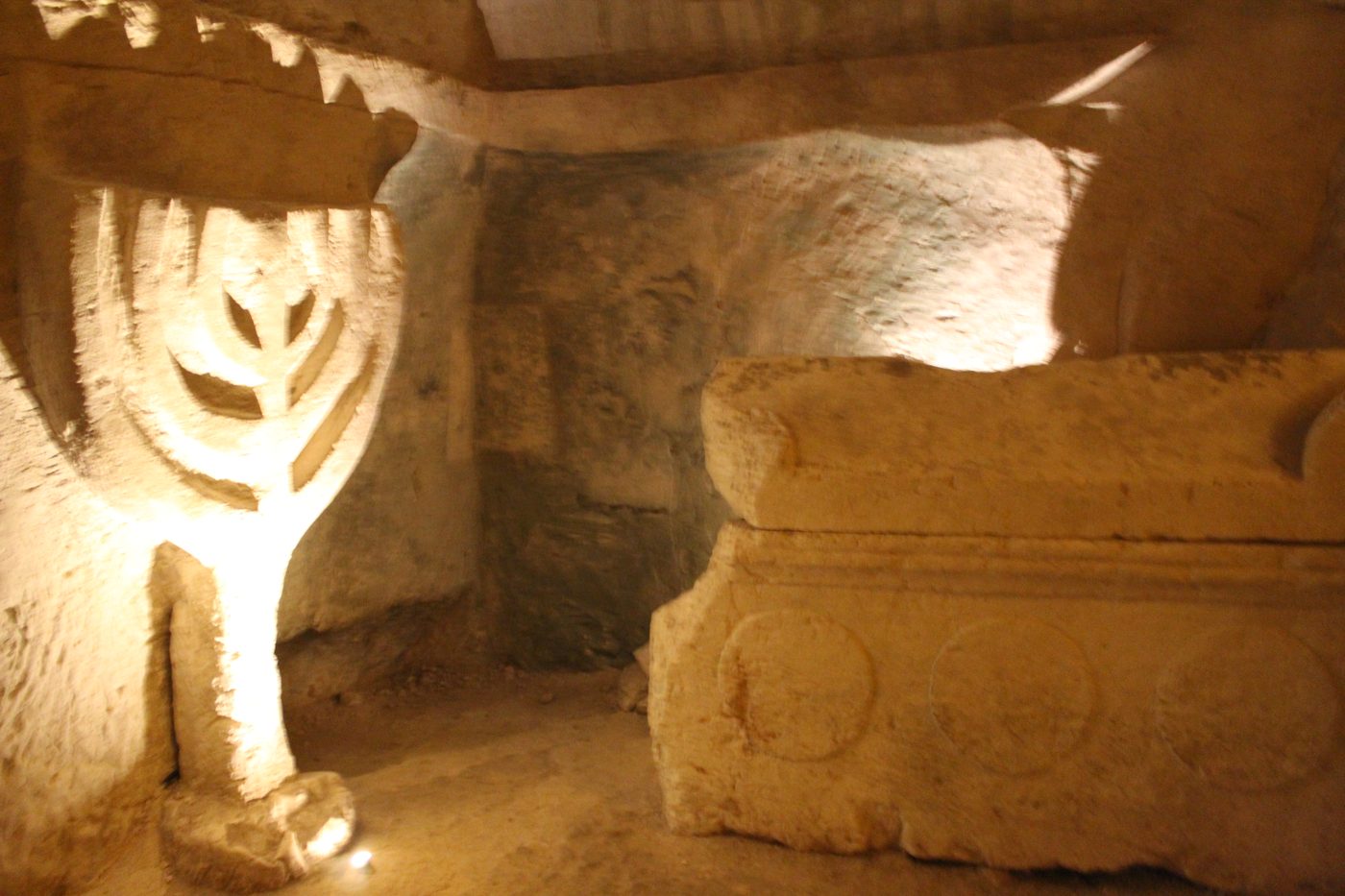
The chisel did not slip. Whoever carved that seven-branched lamp into the limestone wall of the Cave of the Warrior and his Menorah at Beit She'arim knew exactly what they were doing, and they wanted it to last. The Temple in Jerusalem had been rubble for a century or more by the time most of these catacombs were cut. The menorah itself - the great gold lamp-stand that had stood in the sanctuary - was in Rome, on the Arch of Titus, part of a triumph. And yet here it was again, carved into rock in the hills of Galilee, flanked by the dead of a community that refused to accept the conqueror's caption. Not the menorah as trophy. The menorah as home.
Beit She'arim is a hillside necropolis in the lower Galilee, roughly between Haifa and Nazareth. It became one of the most important Jewish burial grounds of the late Roman period, not by accident but by deliberate gravity. When Rabbi Judah HaNasi - the patriarch who compiled the Mishnah, the great written code of oral law - settled the Sanhedrin at Beit She'arim and was himself buried there in the early third century CE, the place became a magnet. Families who wanted their dead to rest near the sages, near the heart of rabbinic authority, sent their dead to Beit She'arim. The catacombs filled. The carvings multiplied.
The record
Beit She'arim is a UNESCO World Heritage Site (inscribed 2015) and has been excavated since the 1930s, principally by Benjamin Mazar from 1936 to 1940 and Nahman Avigad from 1953 to 1958. The site contains more than 30 cave complexes with hundreds of burial chambers. Inscriptions in Hebrew, Aramaic, Greek and Palmyrene indicate a diaspora-wide clientele: families from as far as the Bosphorus, Himyar and Phoenicia brought their dead to Galilee for burial. The Israel Antiquities Authority and the National Parks Authority manage the site today; much of the carved material remains in situ. (Source: UNESCO World Heritage List, entry 1471, 2015; Nahman Avigad, Beth She'arim, vols. I-III, Israel Exploration Society, 1971-1976.)
What makes Beit She'arim remarkable is the range of what the carvers chose to leave behind. Menorahs are everywhere - scratched into plaster, hammered in relief into walls, painted in loculi chambers. But there are also Torah shrines, shofars, lulavim, ethrogim, conch shells, geometric patterns and scenes drawn from Greek and Roman decorative language that the Jewish families here had absorbed without apology. The catacombs at Beit She'arim are not a sealed Jewish world keeping the surrounding culture at arm's length. They are the work of people who lived inside late antique Galilee, spoke Greek and Aramaic and sometimes Palmyrene, commissioned sarcophagi with mythological reliefs, and at the same time knew precisely which symbol to carve when they wanted to say "we are still us." That double fluency - inhabiting the wider world without losing the particular - is the cultural achievement the lamps record.
The record
One of the most-visited chambers at Beit She'arim is known as the Cave of the Warrior and his Menorah, named for its large carved menorah in relief on the wall and an associated warrior figure nearby. The cave belongs to Catacomb 20, which also contains the double sarcophagus traditionally associated with Rabbi Judah HaNasi himself - though scholarly opinion on the precise identification remains cautious. The Greek inscription in the catacomb reading "This is the tomb of Judah the Patriarch" is the closest the site comes to a formal claim. The Talmud (Babylonian Talmud, Ketubot 103b) records that Rabbi Judah HaNasi died at Beit She'arim and was brought for burial there. (Source: Israel Antiquities Authority; Babylonian Talmud, Ketubot 103b; Avigad, Beth She'arim, vol. II, 1976.)
Stand at the entrance of one of the deeper cave corridors at Beit She'arim - the long dark gallery with niches cut into both sides, each niche once sealed with a stone slab bearing a name - and the arithmetic becomes human. These were not anonymous graves. They were people with family titles and honorary epithets. They were children with Greek names whose parents knew the prayers by heart. They were men called "lover of the people" and women noted for their piety. The carvers who scratched the menorahs into the rock near the doorways were not decorating. They were marking the threshold of a Jewish space in the same way a mezuzah marks a doorpost - signing who lived here, and who waited here, and what they still held on to.
The record
More than 250 inscriptions have been recorded at Beit She'arim, making it one of the richest epigraphic sites for late antique Jewish life in the Land of Israel. Greek accounts for roughly 80 per cent of the inscriptions; Hebrew and Aramaic appear in the remainder. Menorah carvings appear in dozens of forms across the caves - some in relief, some incised, some painted - alongside shofars, lulavim, Torah shrines and occasional figurative images. Several inscriptions record the origins of the deceased: communities in Antioch, Sidon, Tyre, Byblos, Palmyra and South Arabia are attested. The width of the catchment area confirms that Beit She'arim functioned as an international Jewish burial centre for diaspora families who wished interment in the Land of Israel beside the rabbinic seat. (Source: Jewish Inscriptions Project, Cambridge; Avigad, Beth She'arim, vol. III, 1976; UNESCO nomination file 1471.)
The Temple lamp was taken to Rome as a symbol of Jewish defeat. The carved lamps at Beit She'arim are something else entirely - a symbol of Jewish continuation, cut into the walls of the living by those who buried their dead in the hills of Galilee and expected to go on living there. Each menorah in the rock is a lamp that needs no oil. It was never going to go out.