In the low hills above the Jezreel Valley, roughly halfway between the coast and the Sea of Galilee, there is a town the rabbis called Beit She'arim - House of Gates. In the second and third centuries CE it was the seat of the Sanhedrin, the nerve centre of Jewish legal life in the Galilee, and, for a time, the burial place of Judah haNasi himself: the great compiler of the Mishnah, head of the Patriarchate, the figure the Roman administration treated as the responsible party for the Jews of Palestine. When he died, around 217 CE, he was buried there. The dynasty he represented, the house of Hillel, had been leading the Jewish community since before the Temple fell. Now it was going to do something else remarkable: it was going to govern.
The office of Nasi - "prince" or "patriarch" - was older than the Roman accommodation, but the third century gave it a strange new weight. Rome needed a counterpart, a tax collector, a legal interlocutor who could keep the considerable and stubborn Jewish population of the eastern provinces in some kind of administrative order. The Nasi fit the role. He was educated, multi-lingual, descended from the house of Hillel and therefore from the line of King David by tradition - exactly the kind of pedigree Rome could negotiate with. The result was an arrangement that lasted nearly two hundred years: a Jewish dynasty operating as a client authority inside the Roman world, issuing ordinances, appointing local judges, collecting a communal tax called the apostole, and sending delegations to Jewish communities as far as Babylon.
The record
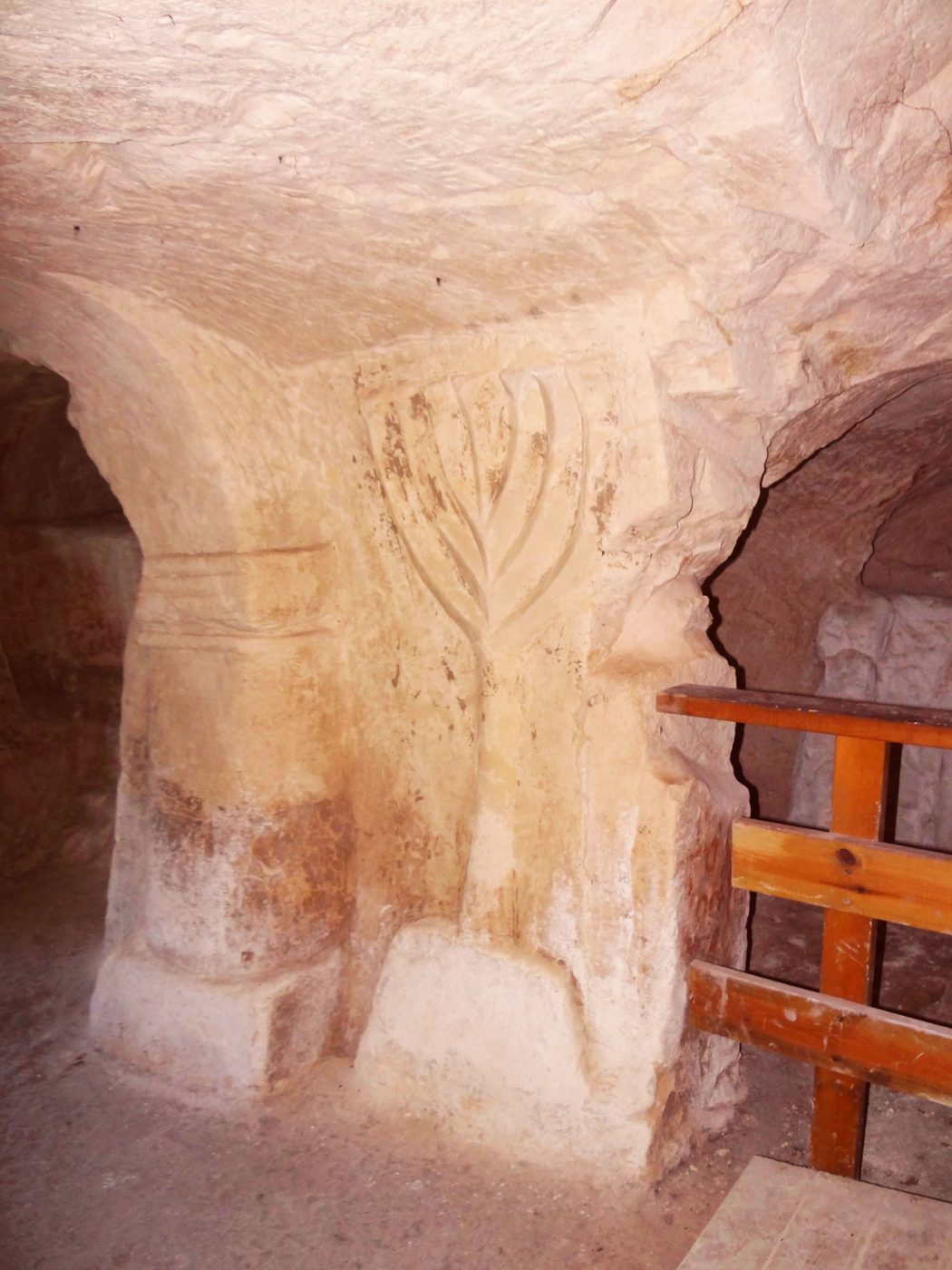
The catacombs at Beit She'arim - excavated systematically by the Israel Antiquities Authority and the Hebrew University under Benjamin Mazar and Nahman Avigad from 1936 to 1958, and inscribed as a UNESCO World Heritage Site in 2015 - contain more than two hundred burial halls and thousands of sarcophagi. Inscriptions in Hebrew, Aramaic, Greek, and Palmyrene testify to Jews arriving from across the diaspora for burial near the Patriarch's tomb. Catacomb 14 includes an inscription identifying the burial of Rabbi Shimon, son of Judah haNasi, alongside members of his household. The necropolis is the physical record of a community that understood Beit She'arim as its spiritual centre while the Patriarchate lasted. (Source: N. Avigad, Beth She'arim: Report on the Excavations during 1953-1958, Israel Exploration Society, 1976; UNESCO World Heritage List, ref. 1393.)
What makes the third-century Patriarchate worth pausing on is precisely this double life. The Nasi operated simultaneously in the world of Roman aristocratic politics and in the world of rabbinic legal reasoning - and both communities accepted the arrangement. To Rome he was a useful client. To the diaspora communities in Babylon - where the other great axis of Jewish life was operating, in the academies of Sura and Pumbedita - the Nasi was the legitimate heir of the Sanhedrin tradition, the man whose calendar rulings and legal opinions arrived by emissary and were taken seriously even when disputed. The Babylonian Talmud (Sanhedrin 36a) records debates in which the authority of the Nasi's court is assumed as a legal category, even by scholars who never set foot in the Galilee. Prestige is a real thing, and the Patriarchate had accumulated extraordinary amounts of it. By the time of Judah haNasi's grandson - Judah II, who led the Patriarchate around the mid-third century - the office was wealthy, politically connected, and occasionally controversial: the Talmud records rabbinic unease at the luxury of the Patriarch's household and the appointments he made. Power courts have always had critics who thought the holder was getting above himself.
The record
A letter from the emperor Caracalla's era, preserved in a later Latin source, refers to the Patriarch (Patriarches) of the Jews as having the rank equivalent to a Roman provincial prefect - a remarkable elevation for a communal religious leader. The Jewish Patriarchs of the third and early fourth centuries are known to have held the rank of clarissimus (senator-class) and later illustris under the late Roman system, granting them significant legal immunities and status. The historian Lee Levine's study The Rabbinic Class of Roman Palestine in Late Antiquity (Jewish Theological Seminary / Yad Izhak Ben-Zvi, 1989) documents the Patriarch's political correspondence, the apostole tax, and the emissaries (apostoloi) dispatched to diaspora communities throughout this period. The arrangement was formally ended only in 429 CE, when the Emperor Theodosius II declined to appoint a successor after the death of the last Patriarch, Gamliel VI, and absorbed the apostole revenue into the imperial treasury.
The Galilean hills where all this took place are still there, and Beit She'arim is still there too - a national park now, the catacombs open to visitors, the stone sarcophagi carved with menorahs and eagles and vine scrolls sitting in the dark exactly where they were placed seventeen centuries ago. The people who commissioned those sarcophagi - merchants from Phoenicia, a family from Palmyra, Jewish communities from across the eastern Mediterranean - chose to make the journey to a Galilean hillside because the Patriarch was buried there, because the Sanhedrin had once sat there, because it was, for a particular century of Jewish life, the nearest thing the scattered tribe had to a capital. The building is long gone. The tombs are permanent.
The Patriarchate was not the whole of Jewish life in late antiquity - it was always in tension with the Babylonian academies, and the rabbis who appear in its records are not always reverential. But it was the face the Jewish world turned toward Rome for two centuries, and it worked: the community survived, the legal tradition developed, and the arguments that had begun at Yavneh continued without interruption. That is what the office of Nasi was for. That is what it did.