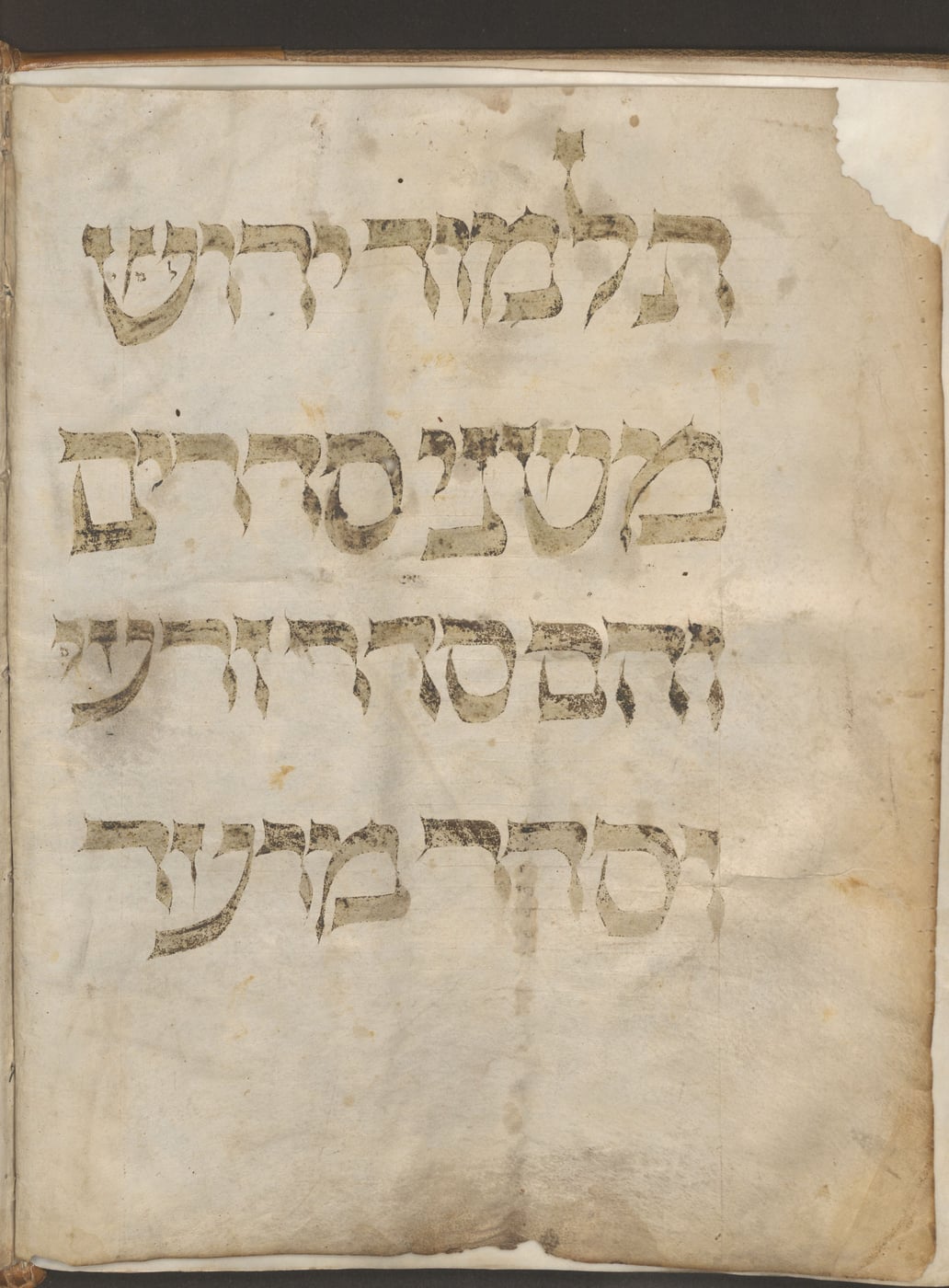
There is a phrase in the Talmud that sounds like a whisper from just outside a closed door: tanya - "it was taught." What follows that word is not Mishnah. It is something older in voice, equally authoritative in pedigree, but not chosen when Rabbi Judah ha-Nasi made his great editorial decision around 200 CE. These are the baraitot (singular: baraita) - the word means simply "outside" in Aramaic, from the root bar, outside. They are the tannaitic teachings left outside the gate of the canon.
No one locked them away. No synod condemned them. They simply did not make the cut when Judah the Prince pruned and shaped the oral tradition into the spare, ordered architecture of the Mishnah. Perhaps a ruling overlapped with another. Perhaps it came from a school whose approach differed slightly from the redactor's. Perhaps there were too many voices and a line had to be drawn somewhere. The rabbis of the Talmudic generations - the amoraim - knew exactly what had been left outside. They kept going to fetch it.
The record
The largest surviving collection of baraitot outside the Talmud itself is the Tosefta - the name means "addition" or "supplement." It runs to roughly four times the length of the Mishnah and follows the same six-order structure, but its material is often more expansive and its rulings sometimes diverge from the Mishnah's conclusions. The Tosefta is cited in the Babylonian Talmud and the Jerusalem Talmud but was not itself standardised until centuries after compilation. The critical edition used by scholars today is Saul Lieberman's Tosefta Ki-Fshutah (Jewish Theological Seminary, 1955-1988), a multi-volume commentary that remains the authoritative reference for the text's transmission history.
What makes the baraitot fascinating is the role they play inside the Talmud itself. The amoraim - who lived after the Mishnah's redaction and whose debates became the Gemara - frequently introduce a baraita to confirm a ruling, to complicate one, or to stage a direct collision between an inside text and an outside one. The formula is almost theatrical: a mishnah states its position; the Gemara begins to analyse it; then, often at a crucial moment, comes tanya, or de-tanya, and the outside teaching arrives like a witness called to the stand. Sometimes it supports the ruling. Sometimes it contradicts it, sending the discussion spiralling in a new direction. The baraitot are not footnotes. They are live participants in an argument that never really closed.
The record
A well-studied example of baraita-versus-mishnah tension appears in tractate Sanhedrin of the Babylonian Talmud (Sanhedrin 74a), where a baraita elaborates capital-crime categories in ways the parallel Mishnah passage does not. The Talmud does not suppress the outside text - it uses the discrepancy to generate legal reasoning. This editorial method, citing baraita against mishnah to drive analysis forward, is documented in detail by David Halivni in Mekorot u-Mesorot (Sources and Traditions, Jewish Theological Seminary, 1968-2003), a multi-volume source-critical study of the Babylonian Talmud's use of tannaitic material.
There are also baraitot that arrived in the academies under specific institutional names - "the school of Ishmael taught" or "the school of Eliezer taught" - traditions identifiable by their characteristic legal logic as much as by their attribution. The tanna de-vei Eliyahu, a later homiletic collection also known as Seder Eliyahu, sits at the mystical edge of this tradition: teachings attributed in the Talmud to the prophet Elijah himself, preserved as baraita-style material, and studied in their own right as a window into the ethical imagination of the rabbinic world. These voices were never fully interior to the canon, yet they never went silent either. They persisted because the tradition trusted the margins as well as the centre - because a teaching that did not make the Mishnah could still be true, and the living argument needed all its witnesses.
The baraitot remind us that no act of canonisation is total. Every sealing of a text leaves something breathing just outside the gate, and in the Jewish case the tradition institutionalised the outside rather than pretending it did not exist. The Mishnah gave the law its backbone. The baraitot gave it its full lungs.