Jerusalem has always had one awkward fact built into it. The city sits high, defensible, all stone and slope and nerves. Its main spring did not. The Gihon rose lower down, on the eastern flank, outside the easy safety of the ridge. That was tolerable in ordinary years. It was less charming when Assyria was moving west and King Hezekiah had every reason to think that Sennacherib might come calling.
So somebody took a decision worthy of the place. If the water lay outside the walls, the walls would be taught to reach for the water underground. A tunnel was cut through the bedrock from the Gihon Spring to the Pool of Siloam, curving for more than half a kilometre beneath the city. According to the inscription later carved into its wall, two teams worked from opposite ends in the dark until, with only a little rock still between them, they heard one another and struck through. Then the water ran.
That last detail matters because the voice we have is not royal. The inscription names no king, boasts for no dynasty, invokes no god-ordained empire. It records labour. Picks, shouting, misalignment in the rock, then breakthrough. It is one of the oldest substantial Hebrew inscriptions we have, and one of the rarest: a public work remembered not in the voice of the court, but in the voice of the men with stone dust in their mouths.

A sentence cut into the dark
The inscription was found in 1880 by a schoolboy exploring the water tunnel, a pupil of Conrad Schick, after centuries in which the passage itself was known but the writing on its wall had gone unnoticed under mineral build-up. The text is damaged at the start, but the heart of it is clear enough. Stone-cutters were working towards one another. Voices were heard through the rock. Then came the meeting, axe against axe, and the water was led into the pool.
It is hard not to love the restraint of that. No trumpet. No curse on enemies. No "thus says" anything. Just the practical exhilaration of the thing coming off. If you have ever been present when stubborn work finally yields, you know the register. The text is elegant biblical Hebrew, but the feeling in it is recognisably human: there you are, under a hill, trusting geometry, luck, sound and nerve, and suddenly the wall in front of you answers back.
The Bible's own account of Hezekiah says he made the pool and the conduit and brought the water into the city. Chronicles adds the strategic logic bluntly enough: why should the Assyrian kings come and find much water? The tunnel and the inscription do not prove every line of the narrative in Kings and Chronicles, but they sit beside it with impressive calm. The city had a water problem. A tunnel was cut. The work was memorable enough to be inscribed. Sometimes the stone and the story do, in fact, recognise one another.
The Siloam Tunnel
A rock-cut water tunnel running from the Gihon Spring to the Siloam end of ancient Jerusalem's water system, roughly 533 metres long. Its winding course and the inscription inside it show that it was cut from two directions and joined underground. Radiometric work has supported a late eighth-century BCE date, often linked with Hezekiah and the Assyrian threat; other excavators have argued for an earlier date in the late ninth or early eighth century BCE. The water, in any case, still gets the last word.
Siloam Tunnel / Hezekiah's TunnelThe workers, not the king
That may be the inscription's most charming defiance of expectation. In the great kingdoms around Judah, public inscriptions usually belong to rulers. Kings build, kings conquer, kings dedicate. Here, by contrast, the surviving text gives us the mechanics of the job. There is no royal self-advertisement in the lines that remain. The men are not anonymous in the modern sentimental sense - we do not know their names - but they are vividly present as workers, which is better. They are heard before they are seen.
This is also why the inscription has become such a treasured object in the history of Hebrew. It is not the oldest Hebrew writing of any kind, and scholars are rightly careful about such competitions. But it is among the oldest substantial Hebrew inscriptions, and it preserves prose that is already poised, already capable of carrying factual narrative without wobble. The Hebrew is not embryonic. It arrives on the wall fully able to report a feat of engineering with style.
There is something fitting in that. Hebrew, in one part of its long life, is the language of blessing and law and poetry. Here it is the language of site notes after a miracle of excavation. The tribe's literature did not float down from the clouds. It came through mouths, hands, tools, walls, measurements and the old demand that water must be where people live.
The later history is less noble. In 1890 the inscription was hacked out of the tunnel wall, damaged in the process, recovered by the Ottoman authorities, and eventually sent to Istanbul, where it remains in the Istanbul Archaeology Museums. That journey is part of the object's history now, whether one likes it or not. The original sits there; the tunnel remains in Jerusalem; casts and replicas have done their dutiful work for generations. The record, like the watercourse, was diverted.
The surviving voice is not royal at all. It is the sound of workers hearing one another through stone, and then breaking through.
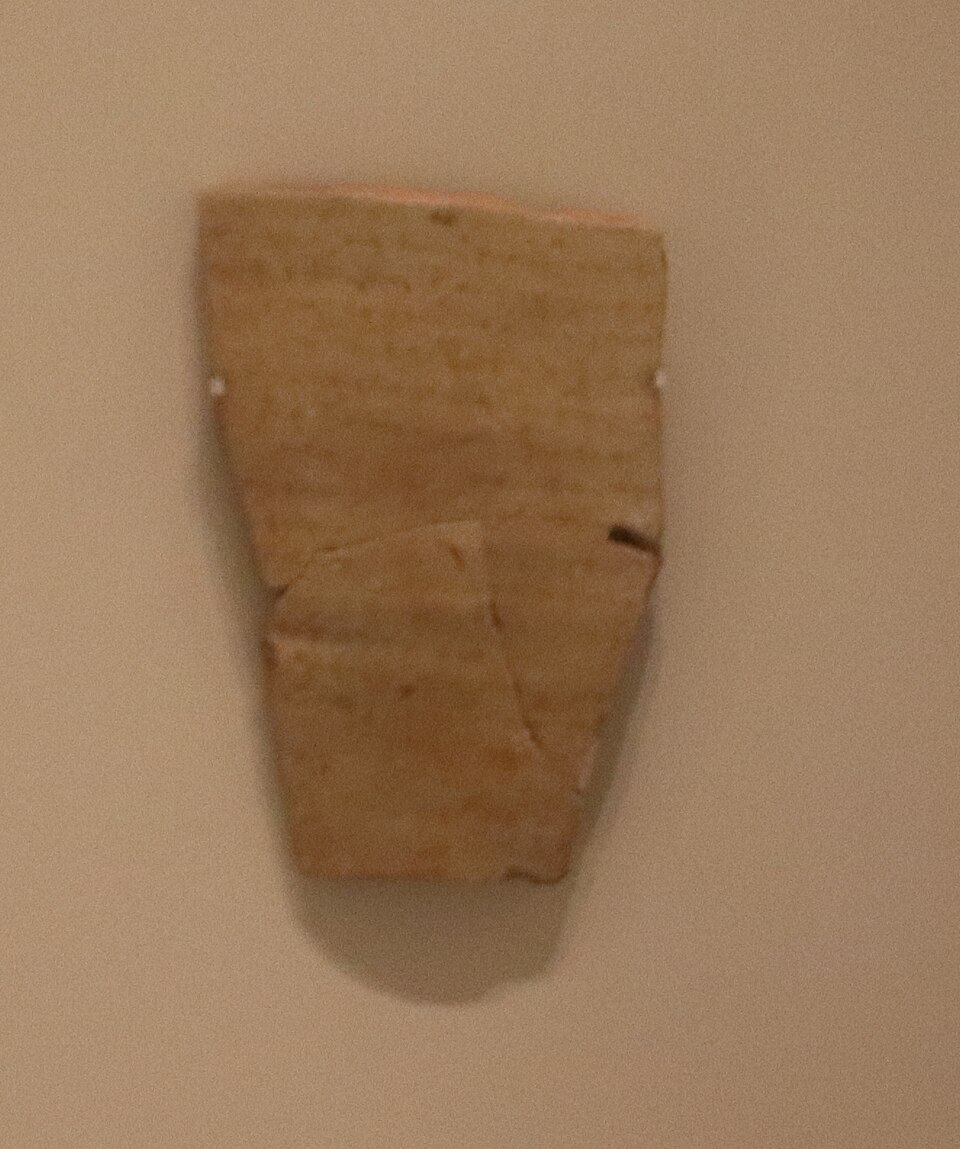
The Siloam Inscription
A six-line Hebrew inscription cut into the tunnel wall near the Pool of Siloam and discovered in 1880 by a boy exploring the passage. The preserved text describes two teams cutting towards one another, hearing voices through the rock when only a short distance remained, then meeting and letting the water flow into the pool. It is the only known ancient inscription from Israel or Judah that commemorates a public construction work. In 1890 it was removed from the wall, damaged into pieces, and later transferred under Ottoman authority to Istanbul.
Istanbul Archaeology Museums2 Kings 20 and 2 Chronicles 32
2 Kings 20:20 remembers Hezekiah for making "the pool and the conduit" and bringing water into the city. 2 Chronicles 32 describes blocking the waters outside Jerusalem so an Assyrian army would not find them. These texts do not quote the tunnel inscription, and the inscription does not name Hezekiah, but together they anchor the same problem: a threatened city, an exposed spring, and a determined effort to bring the water within reach.
Hebrew Bible: 2 Kings 20:20; 2 Chronicles 32:3-4, 30Persistence in the practical mood
Some objects survive because empires treasured them. This one survives because engineers finished the job and somebody took the trouble to mark the moment. The tunnel still exists beneath Jerusalem. The inscription still preserves its clipped little exultation. The biblical memory of water brought into the city still circulates. None of this is theatrical. It is municipal, defensive, practical, a people making sure the spring does not belong to the next army that arrives.
That practicality is part of the pleasure. Jewish history is often told in crowns, scrolls, sieges and sanctuaries. Fair enough. But sometimes the most trustworthy memorial is a line cut by workmen who had no interest in sounding grand. They had done something difficult under pressure, in darkness, with the enemy somewhere out in the future, and they wanted it noted. Quite right too.
So the boast remains, though it is not really a boast in the imperial sense. It is smaller than that and better. We met in the middle. We got the water through. The city endured. For a tribe with a long memory, that is more than enough inscription for one wall.
Further reading