The Roman decree came down: studying Torah was a capital offence. For Rabbi Shimon bar Yochai, this was not abstract. He had spoken too loudly against Roman rule - praised one thing for its own beauty (bathhouses and markets, the Talmud tells us), then corrected himself with what he actually thought: Rome built everything for Rome's sake. Word reached the authorities. A death sentence followed. Shimon, his son Elazar, and a miracle of sustenance - a carob tree that grew at the cave mouth, a spring that appeared from nowhere - went underground. They buried themselves in sand up to their necks by day to preserve their clothes, and studied. They studied for twelve years, and then another year.
When the emperor died and the decree lapsed, they came out blinking into the Galilee - and immediately everything they looked at caught fire. A farmer ploughing. A merchant on a road. The ordinary life of getting and spending burned under their gaze, because they had spent a decade with nothing but the absolute, and the relative world could not bear their eyes. A heavenly voice sent them back. "You are destroying my world. Return to your cave." They went. They studied for another year. When they came out the second time, Shimon could look at his son's destructive glance and offer something cooler to soften it. The world held. They were ready.
The record
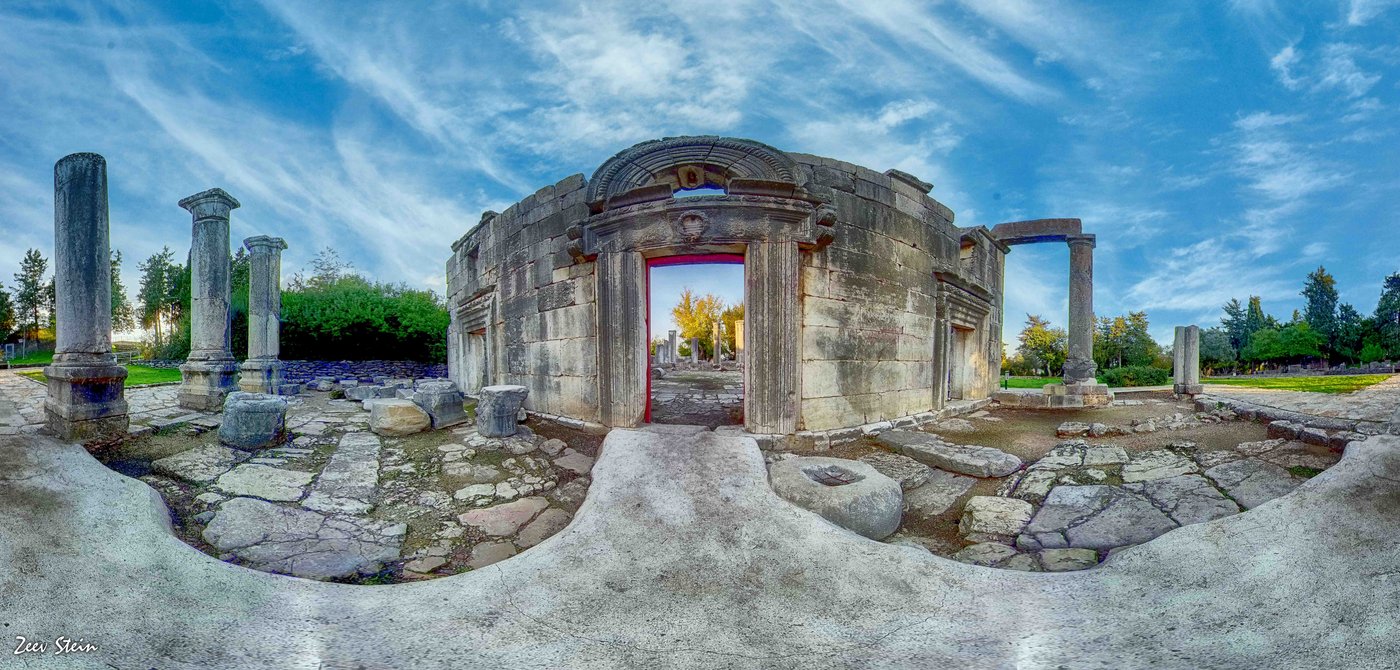
The cave story is preserved in the Babylonian Talmud, tractate Shabbat 33b, compiled in its current form c. 500 CE but drawing on Tannaitic traditions about Shimon bar Yochai (c. 100-160 CE), a fourth-generation Tanna and student of Rabbi Akiva. The Jerusalem Talmud (Shevi'it 9:1) preserves a shorter parallel version. Shimon is a historical figure: he is quoted extensively across the Mishnah and Talmud, and ancient sources including Rabbi Yehuda HaNasi's compilations treat his legal opinions as authoritative. The cave at Peki'in in the Upper Galilee has been identified by local tradition with the refuge in this story; the village retains a Jewish community descended, tradition holds, from the Second Temple period without interruption.
The story is not simply about hiding. The rabbis who shaped it understood exactly what they were doing. Rome could destroy a building; it turned out it could not destroy a curriculum. The cave is the library. Thirteen years of undistracted study produced a man so saturated in Torah that the everyday world - commerce, agriculture, the ordinary Roman province - looked to him like noise. The heavenly voice's rebuke ("you are destroying my world") is the tradition being wise about itself: pure intensity, untempered by ordinary life, burns. The second emergence - one year more, a small refinement in Shimon's capacity to meet ordinary people without incinerating them - is the tradition's way of saying that the goal was not withdrawal. The goal was transformation, then return.
Shimon bar Yochai became one of the most cited sages in the Talmud. His students and their students filled the academies. And the tradition, always busy adding layers, attached his name to something even larger: the Zohar, the central text of Jewish mysticism, is attributed in kabbalistic tradition to Shimon bar Yochai himself - composed, legend says, in that cave. Mainstream scholarship dates the Zohar to thirteenth-century Spain and the circle of Moses de Leon. But the attribution is not mere confusion; it is a statement about what Shimon represents. If mystical illumination entered the world through any doorway, the tradition wants that doorway to be a cave in the Galilee, lit by nothing but Torah and a carob tree.
The record
The Zohar first circulated publicly in the late thirteenth century CE in Castile, Spain, distributed by the kabbalist Moses de Leon (c. 1240-1305). The scholar Gershom Scholem argued definitively in Major Trends in Jewish Mysticism (1941, Schocken Books) and in his monograph on the Zohar (1941, Jewish Publication Society) that de Leon was its principal author, though Scholem acknowledged older traditions and sources were incorporated. The attribution to Shimon bar Yochai - canonised by the tradition and defended by kabbalists through the early modern period, notably by Joseph Karo and Isaac Luria's circle in sixteenth-century Safed - reflects the legend's power: the cave narrative made Shimon the natural patron of hidden, revealed wisdom.
What Shimon bar Yochai's cave story gives the tradition is a usable image of what serious Torah study demands and what it makes possible. Not comfort, not career, not respectability - a Roman province full of bathhouses and markets offers all of those. The cave offers depth. The story knows that depth, unrelieved, scorches. It asks for the full span: the years of intensity, and then the second emergence, carrying that intensity back out into the light without burning the world down. The tribe has been running that experiment ever since.