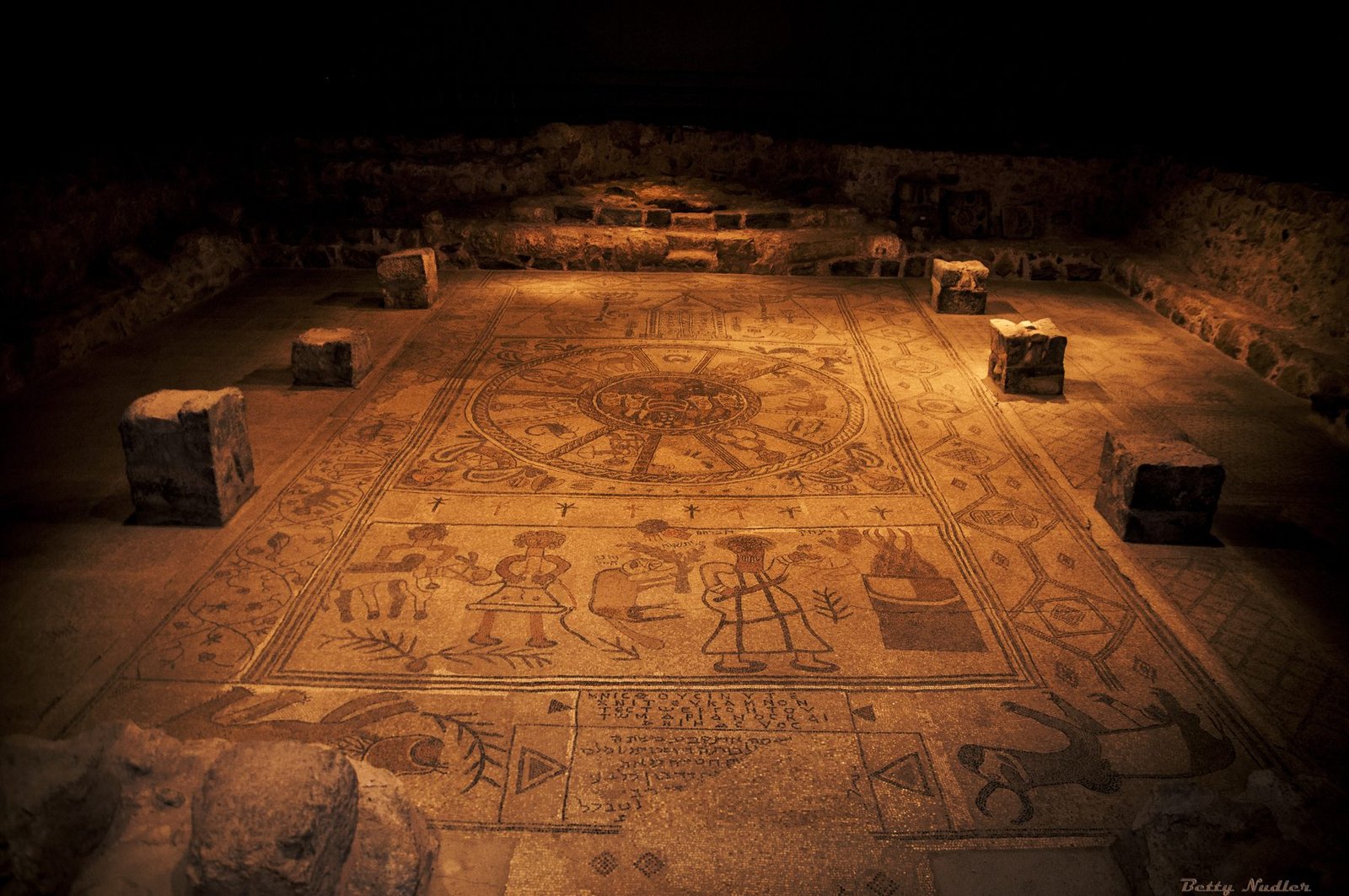
The room was local. The imagination was not. In 2009, during excavations at Magdala, ancient Migdal, on the western shore of the Sea of Galilee, archaeologists uncovered a first-century CE synagogue with benches round the walls, painted plaster, mosaic floor, and in its centre a carved limestone block unlike anything else from the period. One face showed a seven-branched menorah flanked by amphorae and columns. The synagogue was in use before 70 CE, which means the Temple in Jerusalem was still standing when someone in Galilee chose to put its furniture, or something very like it, into stone.
That is why the Magdala Stone lands so hard. It is not only early. It is contemporary. The menorah is not a memory made after catastrophe, not a symbol invented from hearsay after Rome had done its work. It belongs to the late Second Temple world itself. If the carving really echoes the Temple menorah, then the hand behind it may have belonged to someone who had seen the original in Jerusalem with his own eyes. One does not often get that close to another person's line of sight across two millennia.
And the object was not found in Jerusalem. It stood in a Galilean synagogue. That matters because it shows a community praying far from the capital and yet thinking with it, carving with it, and perhaps arranging their own sacred space in its image. A local prayer-house, and the national sanctuary present in relief. The combination is almost indecently rich.

A block that behaves like an argument
The stone is roughly table-sized, carved on several faces, and set on four short legs. On the best-known side, an arch frames the menorah. Beside it stand handled vessels, usually described as amphorae, and columns that make the whole composition feel architectural as well as symbolic. Other faces show arches, rosettes and relief forms that scholars have read in sharply different ways - as furnishing, produce, lamps, gateways, or a stylised interior vision of the Temple itself.
This is where the stone stops being merely handsome and becomes intellectually unruly. If it served as a reading stand or a base for one, that does not make the carvings incidental. It makes them liturgical. The reader would have stood over imagery that drew Jerusalem into the centre of a Galilean room. The Torah above, the Temple below, and the congregation all round. One can see why scholars keep circling it.
The synagogue itself strengthens the point. Magdala was not some marginal hamlet forgotten by history. It was a substantial Jewish town in the first century, and its synagogue is one of the rare excavated synagogues from the period before the Temple's destruction. That gives the stone a setting almost as important as the object itself: a Jewish communal room, contemporary with Jesus, contemporary with the late Temple, and visibly confident in its own material culture.
Discovery in a first-century synagogue
The stone was uncovered during excavations at Magdala in 2009 inside a synagogue dated to the first century CE. The building sits on the Sea of Galilee and was in use before 70 CE, making it one of the small number of known synagogues from the late Second Temple period. The block was found in the main hall, near the centre. The room was not guessing its identity.
Migdal SynagogueThe menorah before the fire
The menorah matters because chronology matters. Jewish images of the Temple menorah become common enough in later centuries, after destruction had turned the object into memory and emblem. The Magdala Stone is different. Its menorah belongs to the period when pilgrims could still go up to Jerusalem and see the sanctuary in service. That is why writers return so often to the possibility that the carver, or the patron, had actually seen the Temple furnishing. It is not sentiment. It is the shortest plausible route between artefact and eyewitness.
There is restraint needed here. "May well have seen" is stronger than the evidence warrants. "May have seen" is fairer. But even the cautious version is arresting enough. Someone in Galilee wanted this image in stone while the Temple still stood. That much is solid.
And the choice of a menorah is not decorative in any lightweight sense. The seven-branched lamp belonged to the symbolic heart of the sanctuary. To place it in a synagogue was to say, at minimum, that the community's prayer and reading life turned consciously towards Jerusalem. At maximum, it was to make a local room resonate as a lesser sanctuary - not a rival Temple, but not merely an assembly hall either.
The dispute is worth keeping alive because the evidence invites it. If the arches and reliefs on the other faces are architectural, the stone starts to look less like decorated furniture and more like compressed sacred topography. If some features are read instead as stylised objects or conventional ornament, the claim becomes more modest. Either way, the stone still records a community that wanted Temple imagery in its synagogue before 70 CE. The smaller claim is already large.
A synagogue in Galilee was not pretending to be Jerusalem. It was refusing to forget where Jerusalem was.
The menorah, amphorae and columns
One face of the block carries a relief of a seven-branched menorah framed by columns and flanked by two handled vessels usually described as amphorae. Because the stone belongs to a pre-70 synagogue context, the relief is among the earliest known menorah depictions and the earliest known example in a synagogue from the Second Temple period. The chronology does the heavy lifting here.
Magdala StoneWhy it matters
The Magdala Stone matters first because it is beautiful evidence of proximity. The synagogue and the Temple overlapped in time. Galilee and Jerusalem were not separate religious planets. A community on the lake pictured the national sanctuary in its own prayer-house while the sanctuary still stood. That tells us something about devotion, memory, and sacred geography before the catastrophe of 70.
It matters second because it unsettles an older scholarly habit of treating early synagogues as merely practical buildings for meeting and reading until the Temple fell. Magdala does not allow that neat division. The stone suggests that symbolic and perhaps even sacral thinking about synagogue space was already underway. Not universally, not necessarily everywhere, but here, unmistakably, in limestone.
And it matters because the object is stubbornly local. This is not theology floating in air. It is a block in a room in a town on the Galilee. Jewish history is full of that pattern: the great centre imagined, quoted, miniaturised and carried outward into ordinary places. The Temple in a Galilee room. The title nearly wrote itself.
Further reading