There is a remark attributed to Sultan Bayezid II, on hearing that Spain had expelled its Jews, that runs roughly: they call Ferdinand a wise king, the one who has impoverished his own country and enriched mine. Whether or not he said it, the policy was real. While one kingdom was emptying itself of Jews, the Ottoman capital was sending for them.
Jews had lived under Byzantium on the Bosphorus for centuries - the Greek-speaking Romaniotes, with their own rite and their own memory. After Mehmed II took the city in 1453 he wanted it repopulated and productive, and Jews were among those resettled into the new capital. Then 1492 changed the scale of everything.
A press within a year
What the exiles brought was not only numbers. They brought a whole civilisation in working order - merchants with letters of credit across the Mediterranean, physicians, scholars, and printers who had learned a new trade in Iberia and Italy. The proof is precise and early: a Hebrew printing press was operating in the city in 1493, barely a year after the boats left Spain.
The Sephardi newcomers reshaped the existing community rather than merging quietly into it. Congregations organised by town of origin - Aragon, Castile, and the rest - kept their own customs and rivalries; the older Romaniotes found themselves a minority in their own city. Out of that crowded, argumentative mix came one of the densest concentrations of Jewish life anywhere.
The first Hebrew press in the Ottoman empire
David and Samuel ibn Nahmias, exiles from Spain, printed Jacob ben Asher's legal code, the Arba'ah Turim, in the Ottoman capital in 1493 - the first Hebrew book produced in the empire, and one of the earliest anywhere outside Italy and Iberia. A community barely off the boats was already setting type.
National Library of Israel; Hebrew printing historyThe boat-shaped reading desk
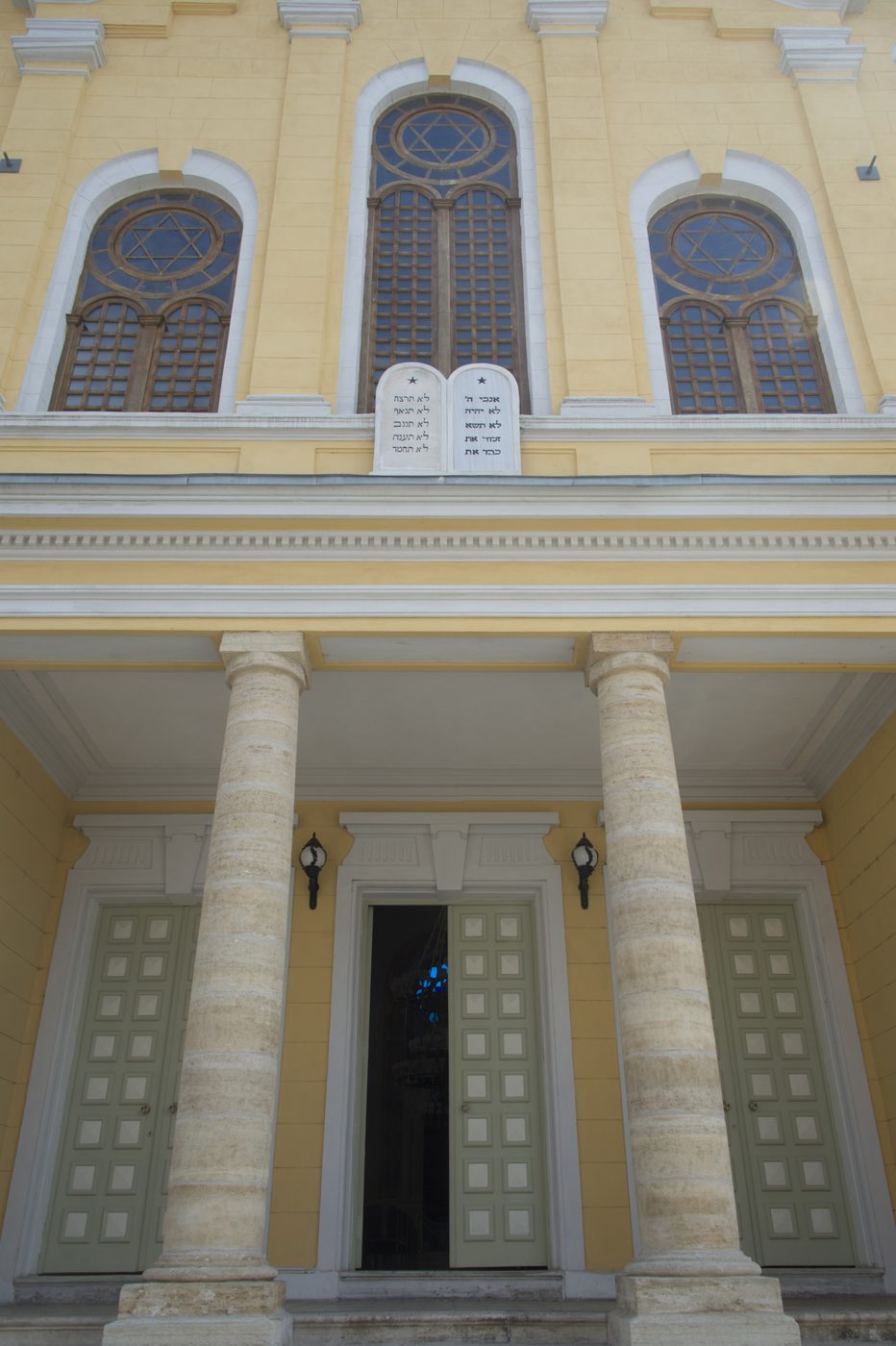
The city's synagogues map its layers. In the old quarter of Balat, hard by the water, the Ahrida synagogue traces its foundation to before the Ottoman conquest, and its reading platform is built in the shape of a ship's prow - read by some as Noah's ark, by others as the boats that carried the exiles to safety. Either way, a congregation chose to pray facing a vessel.
For four centuries the community was a fixture of the capital: a Ladino press and Ladino newspapers, a chief rabbinate recognised by the state, poets and rabbis and traders, and the full weight of ordinary life lived in a language Spain had tried to erase.
One kingdom called itself wise for emptying its cities; another grew great by filling them. Istanbul answered an expulsion with an invitation.
The Ahrida Synagogue, Balat
One of the oldest synagogues in the city, in the riverside Balat quarter, its origins predate the Ottoman conquest. Its distinctive tevah, shaped like the prow of a ship, is among the most recognised features of any synagogue in Turkey. The building still stands and is still used for prayer.
Chief Rabbinate of Turkey; Historic Synagogues of EuropeThe long afterglow
The community is far smaller now than at its height, much of it gathered toward the modern city and much of it departed for Israel and beyond over the twentieth century. But the through-line holds: a city that, at the moment Europe was closing doors, chose to open one, and was richer for it for centuries.
The press of 1493 is the whole story in miniature. Expelled on one shore, typesetting on another, within the year.