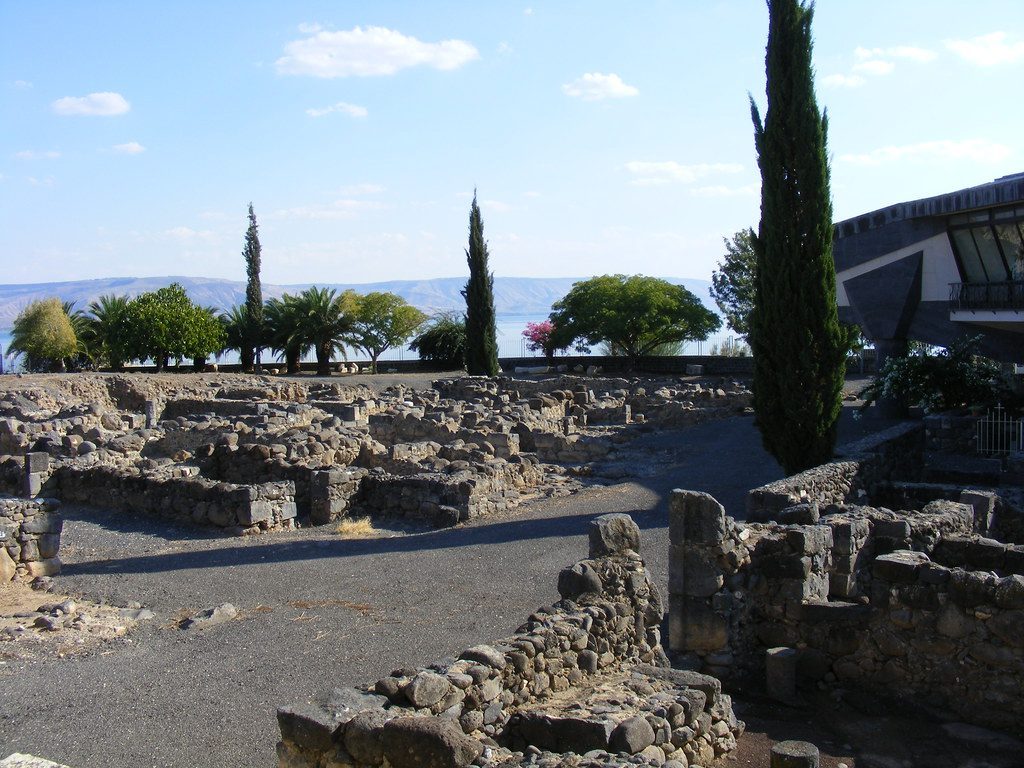
Stand on the saddle of land north of the ruin and the name explains itself. The hill rises in a single steep hump, ravines falling away on three sides, and the ancients looked at that shape and called it a camel. Gamla, from the Aramaic for camel. It is one of those places where the geography is the argument: you understand in a glance why people chose to make their stand here, and why, in the autumn of 67 CE, that choice ended the way it did.
For most of two thousand years Gamla was a story without an address. It lived in the pages of Josephus and nowhere else, a stronghold that fell so completely it could not be found. Then the Golan changed hands, a surveyor matched a spur of basalt to the historian's description, and the camel's back gave up its dead. What had been a sentence in an ancient book became, again, a place you can walk.
The siege
Vespasian brought three legions north to the Golan, his son Titus among the commanders, and laid siege to the town on its ridge. The first assault went badly for Rome. The defenders fought from the terraced houses that climbed the slope, and when Roman soldiers crowded onto the rooftops, the buildings collapsed under their weight, killing many. It was the kind of reverse that ends careers. Vespasian regrouped.
The second assault broke the town. Soldiers of the Fifteenth Legion crept up before dawn and undermined a tower; it fell, the wall was breached, and the legions poured in. Josephus says four thousand were killed by Roman swords and five thousand more went over the cliffs at the town's high edge, some thrown, some leaping. Modern historians treat those numbers warily, since the whole population was probably no more than three or four thousand. But the manner of the fall is why Gamla is sometimes called the Masada of the north - with one honest caveat. This was no calm collective suicide. It was the chaos of a city overrun, men and women going off a precipice in the last minutes of a lost defence.
One of the oldest synagogues yet found
Excavation at Gamla uncovered a synagogue built in the Second Temple period, in use before the town's destruction in 67 CE and therefore securely earlier than 70 CE - among the oldest synagogues known anywhere. It is a rectangular hall of basalt, ringed by tiered stone benches, with a Doric colonnade and a ritual bath beside the entrance. Destroyed in the siege and never reoccupied, it is a Jewish room of the first century preserved exactly as it fell.
Israel Antiquities Authority; Gamla SynagogueWhat makes Gamla extraordinary is that the battle is still lying on the ground. The siege did not become legend here, because no one came back to bury it under later centuries. Archaeologists recovered roughly two thousand ballista stones cut from local basalt, some sixteen hundred arrowheads, and the man-made breach in the northern wall, right beside the synagogue, where the Roman ram went through. Inside the synagogue alone they counted more than a hundred and fifty ballista balls. The room where Gamla prayed is also the room where Gamla was stormed.
The room where Gamla prayed is also the room where Gamla was stormed. The siege never became legend here, because no one came back to bury it.
The site is found and dug
The ruin had been lost until after 1967, when the Golan came under Israeli control. In 1968 the surveyor Yitzhaki Gal identified the basalt spur of es-Salam as Josephus's Gamla by matching it to the historian's description. From 1976, Shmaryahu Gutmann led the major excavations - some fourteen seasons - that exposed the wall, the breach, the round tower, the synagogue and the dense litter of the siege. Later seasons continued the work to the turn of the century.
Israel Antiquities Authority; Gutmann excavationsThe hill today
Gamla now sits inside a nature reserve, and the camel-backed ridge that decided its fate has become, improbably, a place of quiet. Israel's tallest waterfall drops fifty metres in the gorge below, dry by late summer. The largest colony of griffon vultures in the country nests on the cliffs, riding the same thermals that once carried the dust of a siege. A memorial near the trailhead remembers the Golan's modern fallen. You walk down toward the ruin past all of it, and the war you came to read about turns slowly from abstraction into ground underfoot.
That is the gift of a site that was never rebuilt. Gamla is not a reconstruction or a reverent guess. It is the thing itself, stopped at the moment of its loss and held there, so that the defence Josephus described can be measured in arrowheads and counted in fallen stones. The camel kept its dead a long time. It does not keep them quietly any more.
Further reading
Story & Stone · Atlas Places Nº 14
Next on the shelf: Nisibis: Frontier on the Road →