Kfar Nahum means "the village of Nahum" - a Jewish fishing town of black basalt houses on the north shore of the Sea of Galilee, sat astride the great coastal road and minding its own business in the late Second Temple period. It is small. You can walk it in ten minutes. And yet it carries an unusually heavy load of memory, because two of the world's traditions and a century of archaeologists all want to claim the same patch of lakeshore, and the stones have stubborn opinions of their own.
What makes Capernaum precious is not its fame but its ordinariness made visible. Here is an actual Galilean village you can stand in: the lanes between the houses, the basalt thresholds, the press of dwellings against a synagogue. For a period more often read about than seen, that is rare. The Gospels remember it; the Mishnah's world is all around it; and the spade has spent a hundred years deciding which layer belongs to whom.
The village on the road
Capernaum sat on the Via Maris, the international highway running from the Mediterranean coast up towards Damascus, which skirted the northern edge of the village. That position made it a natural toll station - the place where customs were taken on the traffic and the catch, and, in Gospel memory, the post of Matthew the tax collector. It was a working town: basalt houses with shared courtyards, fishermen on the lake, an olive press, the ordinary apparatus of Galilean life. Josephus, who knew the region as a commander, even named a fertile spring of the Gennesaret plain after the place.
At the centre of the modern site stands the building everyone photographs: a synagogue of imported white limestone, raised on the village's black basalt, with carved columns and a stone facade that would not look out of place in a Roman town. Its whiteness against the dark houses is the first thing you notice. Its date is the thing scholars have fought over for the better part of a century.
Robinson sees, Wilson names
Edward Robinson recognised the ruins of Tell Hum and noted a synagogue among them in 1838, but did not connect them to Capernaum. Charles William Wilson identified the site as Capernaum in 1866 and made a small excavation in the synagogue. The modern scholarly history of the site begins with those two moments.
C. W. Wilson, Palestine Exploration FundThe synagogue beneath the synagogue
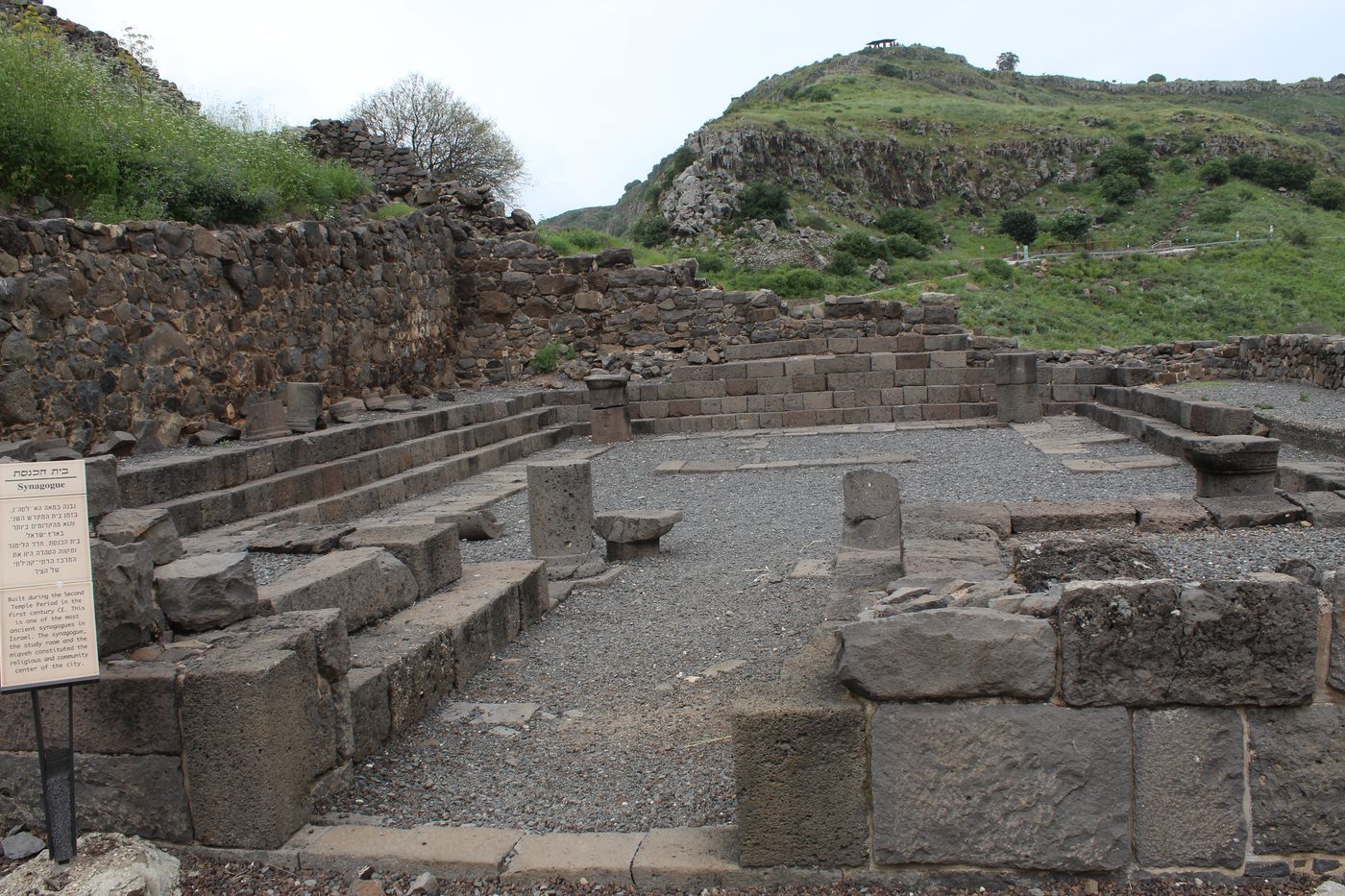
Beneath the white limestone building lie walls and a cobbled pavement of black basalt. The pottery sealed in and under those cobbles points to the first century, and the excavators argued that this earlier basalt structure was itself a synagogue - the candidate, in Christian reading, for the one a Roman officer is said to have built for the village in Luke's Gospel. So the famous white synagogue is not the oldest thing on the spot. It sits on the memory of an earlier house of assembly, which is exactly the sort of layering that keeps an archaeologist up at night.
This is where Capernaum earns its reputation as a place where text and trench keep interrupting each other. The devotional tradition wants the visible building to be old; the stratigraphy keeps insisting it is younger than it looks. Both things can be true at once, which is the whole lesson of the site.
The white synagogue is not the oldest stone on the spot. It rests on the memory of an earlier one.
Dating the white synagogue
Excavations by Virgilio Corbo and Stanislao Loffreda from 1968 recovered thousands of coins and quantities of pottery sealed beneath the limestone synagogue's floors, placing its construction in the late 4th or 5th century CE, over the basalt foundations of an earlier structure. It is among the most complete and recognisable ancient synagogues in the Galilee.
Corbo and Loffreda, Custody of the Holy Land excavationsWhat Capernaum still does
The village was lived in from roughly the second century BCE and declined under the early Islamic rulers, with the old town largely abandoned by about the eleventh century. What survives is a teaching site in the best sense. It shows that a Galilean village can be small and still hold a whole chapter of memory; that Jewish and Christian recollection can overlap on one shoreline without either cancelling the other; and that the surest cure for a confident story is a careful trench. Pilgrims and archaeologists walk the same basalt lanes today, and the stones, as ever, decline to settle the argument for them.
Further reading