There is no craftsman's signature on a shofar. No joinery, no lacquer, no keys or valves, no reed. You take the horn of a ram, clean it, hollow it, heat and curve it slightly if you like, and that is all. The same hand that pressed Abraham's knife down was stopped by an angel, and the ram caught in the thicket by its horns became the first shofar - or so the tradition remembers it, reading the near-sacrifice of Isaac on Mount Moriah as the moment when the ram's horn entered the story. Whether or not you read Genesis literally, the connection is deliberate and old: the blast that opens Rosh Hashanah, the Jewish new year, is a memory of that moment, a call across thirty centuries to the same mountain.
The four calls the shofar makes have names that every Jewish child eventually learns. Tekiah is one long, steady note - a summons. Shevarim is three broken, wailing bursts. Teruah is a rapid staccato, nine short beats that feel like alarm or urgency. Tekiah gedolah is the great sustained note at the close, held as long as the blower's lungs allow, tapering to silence. The sequence is not decorative. Maimonides wrote in the twelfth century that the shofar's task is to wake the sleeping soul - "Awake, you sleepers, from your sleep! Examine your deeds, repent, and remember your Creator." The instrument is a verb, not a noun.
The record
The shofar is the only biblical instrument still in regular use in its original, unmodified form. The Mishnah, compiled around 200 CE, devotes an entire tractate - Tractate Rosh Hashanah - to the rules of blowing: which animals' horns are permitted (a ram's horn is preferred; a cow's horn is excluded because it is called a "horn," keren, not a shofar), how many notes must be sounded, and how to count them. The rules in Rosh Hashanah 3:3-4 specify that a cracked shofar that has been repaired is invalid, because it is the unmediated voice of the horn itself that the law requires, not a human reconstruction of it. This insistence on the raw, unworked instrument is itself a statement about what the shofar is for.
The shofar is not confined to the synagogue calendar. In the biblical period it served at least three distinct functions that we can trace. It was a war signal - Judges 7 records Gideon's three hundred men blowing shofarot to rout the Midianite camp at night, the blast itself a weapon of confusion. It was a civic announcement: the Jubilee year, the fiftieth year of release when debts were forgiven and land returned to its ancestral owners, was proclaimed by the shofar on Yom Kippur (Leviticus 25:9). And it was a signal of divine presence: when the Israelites stood at Sinai, the text of Exodus 19 says the shofar blast grew louder and louder as the revelation intensified, until the entire people trembled. A single instrument carrying war, freedom, and theophany is not an instrument that needs ornamentation. It is already doing too much.
The record
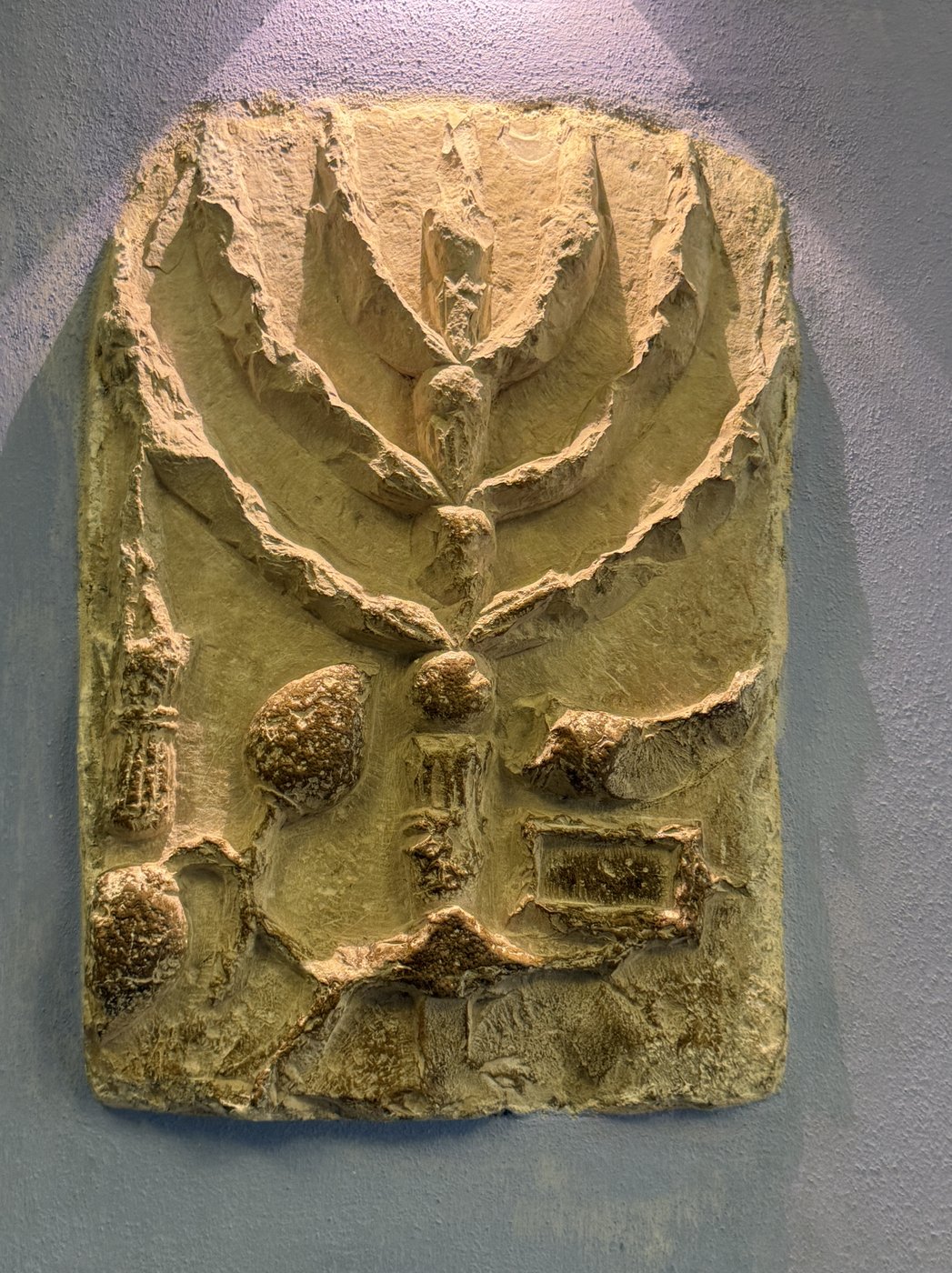
Archaeological evidence for early shofar use includes a carved ivory panel from Megiddo, dated to around 1200-1000 BCE (now in the Oriental Institute, Chicago, OIM A22213), which depicts a procession with musicians holding what appear to be curved animal horns. More directly, a stone relief from the palace of Sennacherib at Nineveh, dating to around 700 BCE and now in the British Museum (BM 124904-124905), shows Judean captives being led from Lachish; some carry possessions that include musical instruments consistent with period descriptions. The Lachish reliefs do not show shofarot explicitly, but they confirm the musical culture of late-First-Temple Judah at precisely the period this node marks. The earliest unambiguous iconographic depiction of a shofar being blown appears on a mosaic from the Hamat Tiberias synagogue, dated to the fourth century CE, where the instrument is shown alongside a menorah and lulav as one of the three central symbols of Jewish life.
What is striking about the shofar's survival is not its age - many ancient instruments are old - but its deliberate refusal to evolve. The lyre and the harp of the Temple vanished when the Temple did; the rabbis forbade instrumental music after the destruction of 70 CE as a sign of mourning, and those instruments never returned to central use. The shofar was exempt, because it is not music in the aesthetic sense. It is a call. A call does not need to be beautiful; it needs to be heard. And so the ram's horn that needed no maker's skill in the time of the Judges needs none today either. You pick it up, you breathe, and thirty centuries answer.
On the hundred blasts sounded on Rosh Hashanah morning, the congregation is not listening to a performance. They are being addressed. The shofar is the only instrument in Jewish life that the law requires you to hear, not merely to play - shome'a ke'oneh, "hearing is as doing," in the Talmudic formula. The blower and the listener are both obligated. The sound moves in one direction, but the responsibility runs both ways. That is not a detail of religious law. It is the whole point.