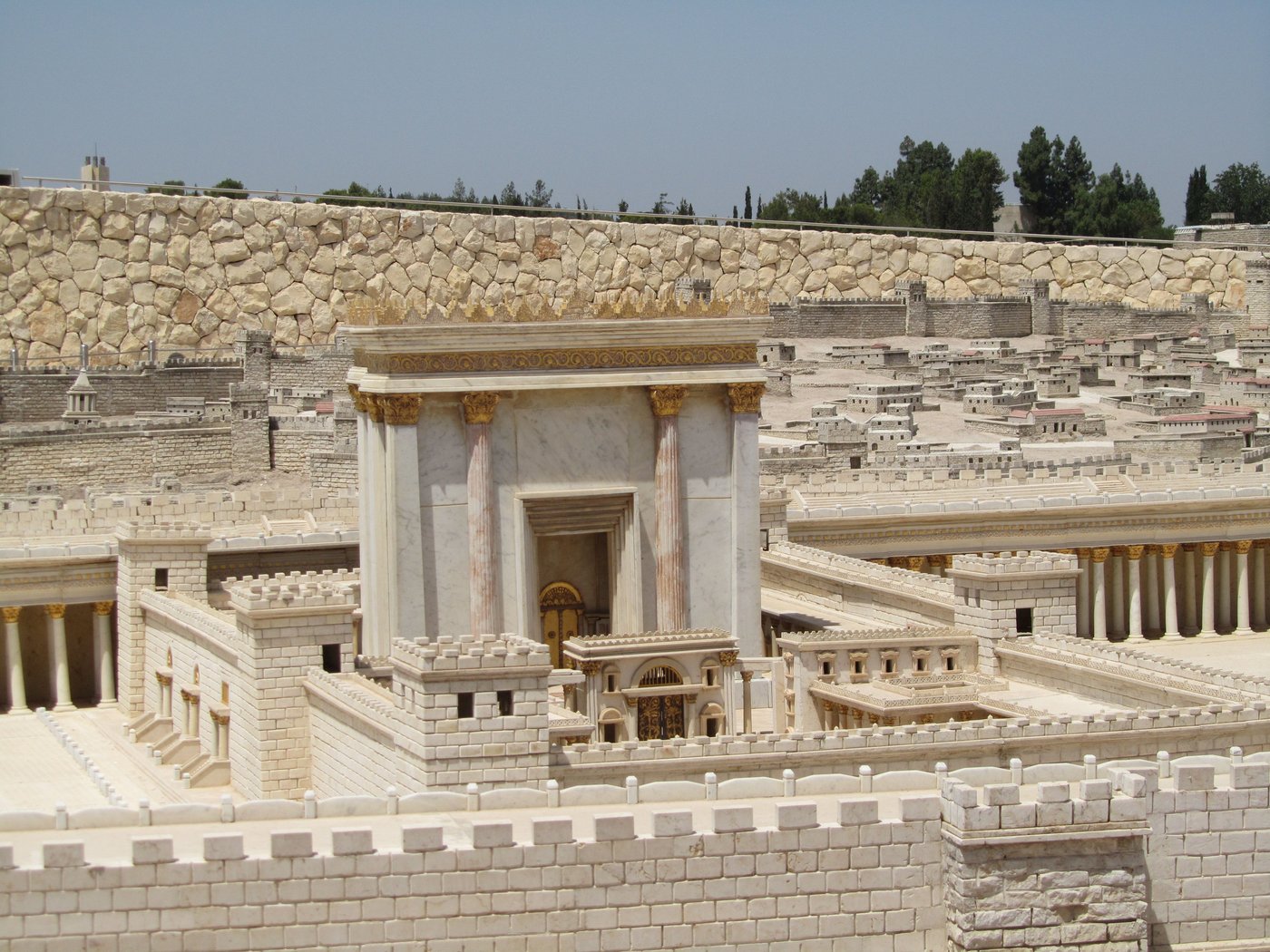
The Levites in the Temple did not sing quietly. They stood on a stone platform - the duchan - and sang in full voice, accompanied by lyres, harps, cymbals, and the high, carrying note of the silver trumpets blown by the priests. The Psalms were not private devotions; they were a liturgical programme, a daily schedule of song assigned to each day of the week, performed before an audience of worshippers in the Court of Israel. Music was not incidental to Temple worship. It was structural. Certain sacrifices could not be performed, the Talmud would later make clear, without the accompanying song. The music and the offering were, in a legal and theological sense, a single act.
When the Temple fell to Rome in 70 CE, that programme ended in a morning. The Levites scattered. The instruments - those that survived the fire and the looting - went silent. And in the years and generations that followed, as the rabbis built the portable religion that would carry the Jewish people through exile, they made a ruling that encoded the loss into the texture of daily life: instrumental music was to be avoided as an act of mourning for the Temple. No harp at a wedding feast, no strings at a celebration. The voice - the unaided, unaccompanied human voice - would have to serve.
The record
The rabbinic prohibition on instrumental music in mourning for the Temple is reflected in late rabbinic sources, especially Sotah 48a, which records that when the Temple was destroyed the sages decreed that musical instruments (kli shir) should cease from wedding feasts - a ruling meant to mark ongoing mourning for the Sanctuary. This tractate also lists what pleasures were curtailed as memorials of the destruction. The passage in Sotah 48a is among the earliest datable sources for the systematic suppression of instrumental music as a communal mourning gesture, and it sits within the broader Talmudic conversation about what the post-70 world owed to the memory of the Temple.
The practical consequence of the rabbinic ruling was enormous - and largely invisible to those who grew up inside it. Synagogue worship, which had existed alongside the Temple as a house of prayer and study, now became the central institution of Jewish religious life without the musical apparatus the Temple had possessed. The chazan - the prayer leader - sang, but without instruments. The congregation responded, and that responsorial structure, voice calling to voice, became the architecture of Jewish liturgical music. Modes, melodic formulas called nusach, the cantillation of Torah readings: all of these evolved in the medium the rabbis had left available - the throat, the breath, the unmediated human instrument. What might have seemed a privation became, over centuries, an astonishing tradition of vocal sophistication. The silence of the strings made room for something that could not have grown any other way.
The record
The Mishnah, tractate Arachin 2:3-6, preserves detailed information about the Temple music programme: the minimum number of Levitical singers (twelve), the instruments used (the nevel or harp, the kinnor or lyre, the chalil or pipe, and cymbals), and the specific Psalms assigned to each day of the week (Psalms 24, 48, 82, 94, 81, 93, and 92 for Sunday through Sabbath respectively). This material reflects a careful preservation of Temple practice at a point when practice itself had ceased - the Mishnah was compiled around 200 CE by Rabbi Yehudah HaNasi, some 130 years after the destruction. The fact that these details were recorded with such precision at all is itself a statement: the rabbis intended the memory of Temple music to be maintained, even as they ruled against its recreation. Scholars of Jewish liturgical music, including the musicologist Abraham Zvi Idelsohn in his landmark Jewish Music in Its Historical Development (Holt, 1929), have traced the lineage of synagogue modal systems - the nusach - back to the vocal practices that outlasted the instruments.
The prohibition was never absolute, and Jewish legal discussion has circled it for centuries. Authorities debated whether a professional musician could play for a living, whether music was permissible for the sake of a mitzvah, whether the ban applied only to celebratory contexts or to all instrumental sound. In practice, Jewish communities in different regions found their own accommodations: Yemenite Jews maintained certain instrumental traditions in domestic contexts; Hasidic communities made vocal music - niggunim, wordless melodies hummed at the table - into a spiritual technology of extraordinary power precisely because the instrument was the self. The Sephardic piyyut tradition, the Ashkenazic cantorial art, the call-and-response of the prayer house: all of these are what grew in the space the ruling opened. The silence was not an absence. It was a container.
The record
Later Ashkenazic cantorial art developed almost entirely within the framework of unaccompanied or minimally accompanied vocal music. Earlier, in Venice, Salomone Rossi published Ha-Shirim Asher liShlomoh in 1622-23 - a landmark collection of Hebrew polyphony, but not part of the later cantorial line. The introduction of the organ into the synagogue in the 19th-century Reform movement was one of the most contested liturgical changes of that era precisely because it broke against the mourning prohibition that had held for nearly eighteen centuries. The debate is documented in the responsa literature of the period; the scholar Leon Modena had already argued for limited musical instruments in the synagogue in his Historia de' riti hebraici (Venice, 1638). The Jewish Music Research Centre at the Hebrew University of Jerusalem holds extensive archival material on the cantorial tradition and the development of synagogue music from the post-Temple period to the present.
A silence imposed by grief became the condition for a tradition. The Temple musicians lost their stage in 70 CE, but their successors - the cantors, the prayer leaders, the singers of wordless niggunim - carried something forward that instruments alone could never have preserved: the sound of the people itself, breathing together, shaped by the same melodies passed mouth to ear across a hundred generations. The lyre was taken. The voice was not.