Rabat does not shout about its Jewish past. It keeps it in the mellah, the houses, the restored synagogue and the memory of families who knew both the Atlantic and the Moroccan court. The city's Jewish life grew with returnees and merchants, not with fanfare.
That is part of its charm. The quarter was never just a ghetto in the crude sense. It was a working district with its own pride, close enough to the centre to matter and close enough to the water to remember departure.
A city of return and mercantile nerves
In the seventeenth century, converso returnees joined existing families in Rabat, and the city's Jewish quarter grew more distinct. Like many Moroccan mellahs, it sat near power and commerce, which meant Jewish life there was both protected and exposed.
The best Jewish cities often understand trade as a social language. Rabat certainly did. Merchants, communal elders and rabbinic families all spoke it fluently, and the quarter kept its balance by remaining useful.
The quarter gains a public house
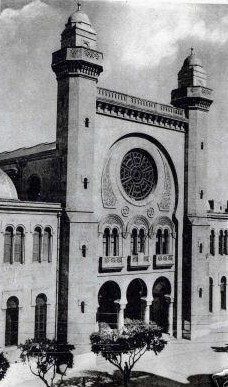
The Rabbi Shalom Zaoui Synagogue, in the mellah of Rabat, stands as one of the city's clearest surviving Jewish markers. It embodies a quarter that grew through return and trade rather than through grand scale.
Rabbi Shalom Zaoui Synagogue; DiarnaThe sea takes the people away
After 1948, and especially between 1948 and 1961, the community emigrated almost entirely to Israel and France. That departure was not a simple ending. It was the closing of a long Atlantic chapter, and it left the quarter quieter than it had been for centuries.
The city did not become empty of memory. It became selective. The living community became small, but the restored places kept the old Rabat from being swallowed by the new one.
The city's Jewish history is still legible in the restored synagogue and in the wider Moroccan effort to keep Jewish heritage public. That is the proper way to read Rabat now: not as a vanished world, but as a world that chose a thinner future.
The quarter returned to the atlas because the quarter never entirely left the city.
A mellah can be both refuge and harbour. Rabat knew how to be both.
Almost the whole community leaves
Between 1948 and 1961, most of Rabat's Jews emigrated to Israel and France. The departure was near-total, but the place they left behind still carries the outline of the life they built there.
World Jewish Congress; History of the Jews in MoroccoRabat still keeps the outline
Rabat matters because it shows how a community can be both local and ocean-facing. The city was not provincial. It was watchful.
That watchfulness left a quarter, a synagogue and a memory strong enough for the atlas.