A man walks out of Auschwitz, Warsaw, Dachau and Mühldorf having lost his wife and ten of his children, and within twenty years he has built a neighbourhood, a yeshiva and a hospital on the Israeli coast. That is the short version of Netanya's Sanzer story, and it is not a story of survival. It is a story of building. The Klausenberger Rebbe did not come to the Mediterranean to recover. He came to construct, and Kiryat Sanz is what he constructed.
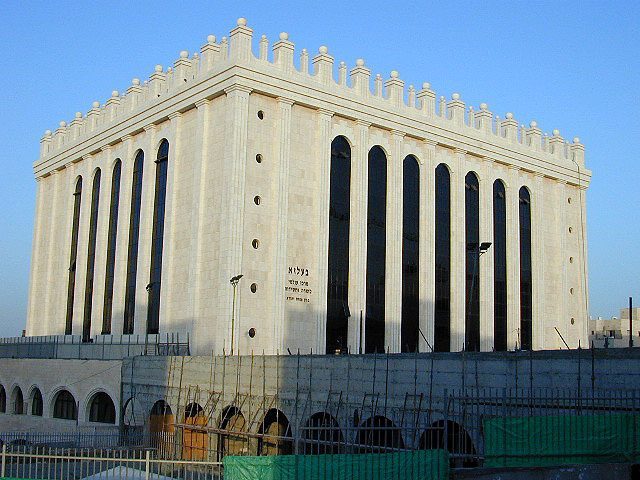
Netanya itself was a young town, founded in 1929 and named for the American philanthropist Nathan Straus, a citrus and seaside place still deciding what it would be. Into its north-western edge in the 1950s came a Galician Hasidic court that had been almost entirely murdered in Europe and almost entirely rebuilt in Brooklyn. The court did not blend in. It built its own quarter, with its own institutions, on a low rise above the sea. Most relocations dissolve a little in the move. This one hardened.
The Sanz dynasty was old before any of this. It was founded in the Galician town of Nowy Sącz - Sanz, in Yiddish - by Rabbi Chaim Halberstam in the nineteenth century, and by the eve of the war it was one of the substantial Hasidic houses of central Europe. The war took the house apart. The man who put it back together was Chaim Halberstam's great-grandson, and he carried both the lineage and the loss in the same body.
The man who would not stop building
Yekusiel Yehudah Halberstam was born in 1905 in Rudnik, in Austrian Galicia. He survived the camps, spent the immediate postwar years among the displaced of occupied Germany, and in 1947 re-established his court in Williamsburg, Brooklyn. He could have stayed. Brooklyn was safe, and full of survivors, and rebuilding well. He chose to plant the centre of the dynasty in Israel instead, on land he asked the young state to grant for a settlement of Holocaust survivors.
The cornerstone went down in Netanya in 1956. The Rebbe himself, with his family and a core of followers, made the move from Brooklyn at the turn of the 1960s, and from then on Kiryat Sanz was the world centre of Sanz-Klausenburg Hasidism rather than a branch of it. There is a particular kind of confidence in that decision. A man who had every reason to guard what little remained instead spent it on schools and bricks and a hospital that would not exist for years.
That hospital is the part outsiders remember. Laniado Hospital, which the Rebbe founded in Kiryat Sanz and which opened in the 1970s, is run according to Jewish law and is known, accurately, as the Israeli hospital that has never closed for a strike. A survivor who had watched medicine used as an instrument of murder built a place whose first principle was that no patient would ever be turned away. The symbolism is almost too neat to be true. It is true anyway.
A court lands on the coast
Rabbi Yekusiel Yehudah Halberstam laid the cornerstone of Kiryat Sanz, on the north-western edge of Netanya, in 1956. He and his immediate community moved there from Brooklyn around 1960, and the neighbourhood became the world centre of the Sanz-Klausenburg Hasidic dynasty. The dates mark the transfer of a dynastic world from destroyed Europe to a functioning Israeli city.
Wikipedia: Kiryat Sanz, Netanya · Yekusiel Yehudah HalberstamWhat a relocation actually costs and keeps
It is worth being exact about what moved and what did not. The buildings did not move; they were lost. The cemeteries did not move; they remain in Poland and Romania and the ash of the camps. What moved was harder to photograph and harder to destroy: a way of praying, a melody, a calendar of obligations, a chain of teachers and students, the assumption that study is the centre of a life. The Rebbe carried that across an ocean and set it down on a hill above Netanya, and it grew.
And it grew without sentimentality, which is the impressive part. Kiryat Sanz is not a memorial. It is a working neighbourhood with schools full of children, charities that move money quietly, synagogues that fill on a Friday, and a hospital that takes all comers. The European court is gone. The house is not. It simply faces the sea now instead of the Carpathians, and it goes on.
A man who lost almost everything in Europe did not come to the coast to recover. He came to build, and he did not stop.
The man behind the neighbourhood
Yekusiel Yehudah Halberstam, the Klausenberger Rebbe, was born in 1905 and died in Netanya in 1994. His first wife and ten of his children were murdered in the Holocaust. He was a direct male-line great-grandson of Chaim Halberstam, the nineteenth-century founder of the Sanz dynasty in Nowy Sącz. The neighbourhood, the yeshiva and Laniado Hospital were all founded under his hand after the war.
Wikipedia: Yekusiel Yehudah Halberstam · Laniado HospitalFurther reading
Story & Stone · Atlas Places Nº 10
Next on the shelf: Slabodka: The School of Grandeur →