Casablanca is the youngest of the great Jewish cities, and one of the largest there ever was. In the middle of the nineteenth century it was a modest Atlantic port - a few thousand people, a small Jewish presence, a place you passed through. A century later it held more Jews than any other city in the Arab world. The growth was not gradual. It was a tide, and Jews from every corner of Morocco came in on it: the old families of the coast, merchants from Marrakesh and Mogador, and a great working class drawn up from the mellahs of the interior and the south.
What pulled them was simple. Under the French Protectorate, declared in 1912, Casablanca became Morocco's economic capital almost overnight, and a fast-growing commercial city has work, money and air. The community that gathered there was mixed in the thoroughly Moroccan way - rich and poor, urban and rural, devout and modern - all crowded into the same boom town, building synagogues and schools and a future that, for a few astonishing decades, looked open.
The largest in the Arab world
The numbers tell the story plainly. Around 1900, Casablanca held perhaps six thousand Jews; by the 1930s the figure had passed forty thousand, and by 1948 it stood at around seventy thousand. The city had become the single largest Jewish community in Morocco - and Morocco itself, with roughly a quarter of a million Jews at mid-century, was the largest Jewish community in the entire Arab and Muslim world. That is not a footnote. It is the scale of the place. Casablanca alone held more Jews than many a famous European centre.
It was not only large; it was layered. Through the Second World War, Morocco fell under Vichy France, and antisemitic decrees were pressed on the country. The community came through it without deportations - a fact for which Moroccan memory credits Sultan Mohammed V, who declined to fully enforce the worst of the Vichy measures, though historians debate the precise extent of his protection. When the Allies landed at Casablanca in November 1942 in Operation Torch, the city's Jews were still there to see it - and, two months later, to know that Roosevelt and Churchill were conferring in their town.
Seventy thousand in one city
By 1948 Casablanca held around 70,000 Jews, the largest Jewish community in Morocco, within a national Jewish population of roughly 250,000 - the largest in the Arab and Muslim world. A 1952 count recorded close to 75,000 Jews in the city. Casablanca had become a great Jewish metropolis in barely two generations.
Jewish Virtual Library; Moroccan census figuresThe great departure
Then, almost as fast as it had gathered, the community left. The founding of Israel in 1948, the end of the Protectorate and Moroccan independence in 1956, and the general unsettling of Jewish life across the Arab world all turned the tide outward. The largest single movement came with Operation Yachin, run by Israel's Mossad in coordination with the Moroccan authorities, which carried somewhere around ninety to ninety-seven thousand Moroccan Jews to Israel between 1961 and 1964. Casablanca, with its port and airport, was the great staging ground of that exodus. The city that had assembled the community now watched most of it embark.
In two generations Casablanca built the largest Jewish community in the Arab world. In three years, most of it left.
Operation Yachin
Operation Yachin, organised by Israel's Mossad with the Moroccan state and assisted by the Jewish Agency, moved roughly 90,000 to 97,000 Moroccan Jews to Israel between November 1961 and 1964, chiefly by sea and air from Casablanca and Tangier. It was the largest single phase of the Moroccan Jewish emigration, and Casablanca was its principal departure point.
Operation Yachin - Mossad and Jewish Agency recordsWhat the city still keeps
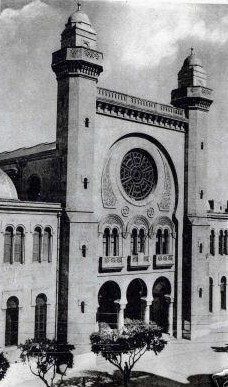
Casablanca did not empty entirely, and that is the point worth ending on. It remains the home of the great majority of Morocco's remaining Jews - a community now numbered in the low thousands, with active synagogues, a working communal life and the Temple Beth-El at its centre. The cemeteries are tended. The museum keeps the record. And Morocco, almost alone in the region, has chosen to treat its Jewish past as part of the national story rather than an embarrassment to be tidied away. The largest Jewish city the Arab world ever built is much smaller now. It is also still, quietly and stubbornly, a Jewish city.
Further reading