The rabbis who shaped Jewish law in the centuries after the Talmud was sealed looked back at their own history and found a pattern: the Torah had never been carried by one person alone. From the Maccabean age to the generation of Hillel and Shammai, it passed through pairs - zugot in Hebrew, the word meaning simply "yokes" or "couples." Five pairs across roughly two centuries, each pair comprising a nasi (president of the Sanhedrin) and an av beit din (head of the court), holding between them both the authority to lead and the authority to judge. The arrangement was not accidental. To hand the law to one man was to invite a monarch. To hand it to two was to keep argument alive.
The Mishnah lists all five pairs in tractate Avot - the famous "chain of tradition" - and the rabbis of the Talmud had much to say about what each pair contributed. Most of them are dim figures to us now: names attached to a handful of preserved rulings, shadows behind the text. Yose ben Yoezer and Yose ben Yochanan are first, active around 170 BCE in the shadow of Antiochus IV's persecutions; Yehoshua ben Perachyah and Nitai of Arbel come next; then Yehuda ben Tabbai and Shimon ben Shetach; then Shemaya and Avtalyon. And then - luminous, unmistakable, standing at the edge of the Common Era - Hillel and Shammai.
The record
The chain of the five pairs (zugot) is recorded in Mishnah Avot 1:4-12 (compiled c. 200 CE, though drawing on oral traditions centuries older). The tractate names each pair in sequence, attributing a short maxim to each. Yose ben Yoezer, the first of the five presidents, is also mentioned in 2 Maccabees 14 as a leading Pharisee figure during the Maccabean revolt, placing him firmly in the mid-second century BCE. The system of dual leadership - nasi and av beit din - is discussed and analysed in the Babylonian Talmud, tractate Hagigah 16a, which records a series of disputes between each pair over a specific legal question (the laying of hands on a sacrificial animal on a festival day), showing the pairs as genuine intellectual adversaries, not ceremonial partners.
What the pairs actually argued about, in most cases, is not well preserved. The Talmud records their disagreements on the semichah question - whether one could lay hands on a festival offering - and that dispute alone stretches across four of the five pairs, the same question returning generation after generation with different votes. This is not accident or poor record-keeping. It is a demonstration of method. The law did not resolve by fiat; it accumulated a history of disagreement that the tradition preserved as carefully as it preserved the rulings themselves. To know that Shammai's school and Hillel's school differed was itself knowledge. The minority opinion was never simply erased.
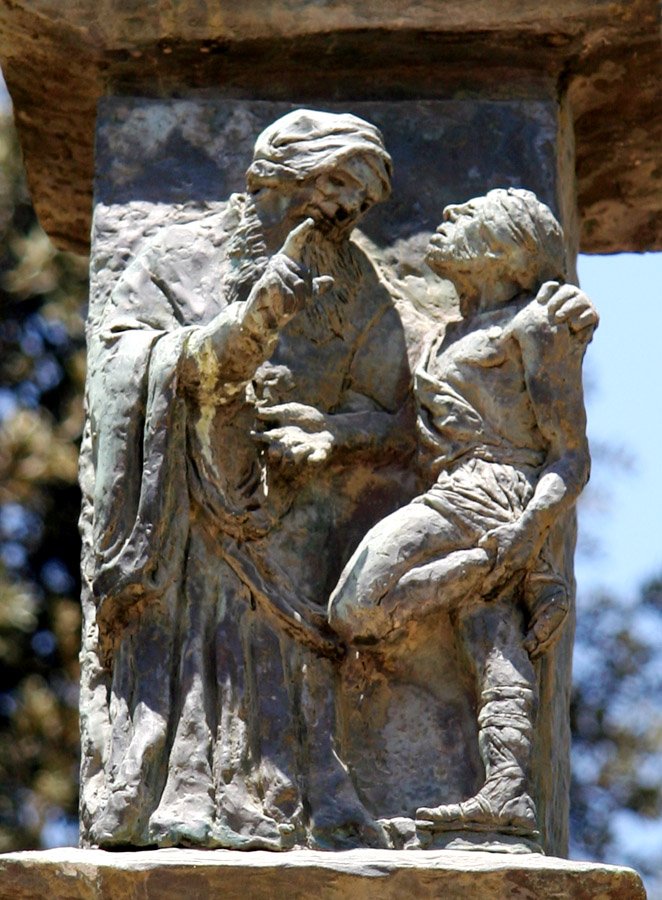
Hillel, who came from Babylonia to Jerusalem and worked as a day labourer before making himself into the greatest legal mind of his generation, is the pair's dominant figure in memory. His formulation of the entire Torah as "what is hateful to you, do not do to your neighbour" - given to a sceptic who demanded to learn the law while standing on one foot - became the tradition's most quoted summary of itself. Shammai, who sent that same sceptic away with a builder's measuring rod, is remembered for strictness. But the Schools of Hillel and Shammai that proliferated after their deaths were not simply lenient versus strict. They were two sustained ways of reading, two habits of legal imagination, that kept each other honest for generations.
The record
The story of Hillel's "golden rule" response to the gentile convert appears in Babylonian Talmud Shabbat 31a. Hillel's dates are generally placed c. 110 BCE - 10 CE, though the chronology is uncertain; Shammai's slightly later, active from roughly 50 BCE. The Talmud records more than 300 specific legal disputes between the two schools (Beit Hillel and Beit Shammai) across tractates including Yevamot, Berakhot, Gittin and Shabbat. The general principle that the law follows Beit Hillel (with a famous handful of exceptions) is stated in Babylonian Talmud Eruvin 13b, where a heavenly voice (bat kol) is said to have ruled in Beit Hillel's favour because "they were kindly and modest and they taught their own rulings and those of Beit Shammai, and they even taught the rulings of Beit Shammai before their own." The Jewish Encyclopaedia (Isidore Singer, ed., Funk & Wagnalls, 1901-06) gives the fullest early summary of both Hillel and the zugot sequence in its articles on each figure.
Shemaya and Avtalyon, the fourth pair, are remarkable for a different reason: the Talmud names them as descendants of converts, not born into Israel's lineage at all. They led the Sanhedrin in Jerusalem's most politically fraught decades, under Hasmonaean decline and the first rumble of Roman power. The tradition not only accepted this but celebrated it - Shemaya's maxim in Avot 1:10 tells disciples to love labour, to hate lordship, and to seek no intimacy with the ruling power. Words shaped by a man who knew exactly what ruling power could do, and chose to stand apart from it. The law, in his generation as in every generation of the pairs, was not a possession of the powerful. It was what you taught, argued over, and passed on.
The era of the zugot ended with Hillel and Shammai, and after them the title of nasi stayed in Hillel's family for centuries - the patriarchate that would eventually produce Yehudah HaNasi, compiler of the Mishnah. But the method the pairs embodied did not end. Every page of the Talmud is structured as a pair: one voice, then another, then the negotiation between them. The zugot were not merely an administrative arrangement for a particular historical moment. They were the form that Jewish learning took, and still takes - law as dialogue, truth as something two people hold together, each preventing the other from going too far alone.