Herod understood something that kings in every age either grasp or miss: the building tells people what you intend. He had been given Judaea by Rome, he was not quite trusted by the priests, and he was not quite accepted by the people. So he built. Not domestic palaces alone - though those were spectacular - but the Temple. The holiest place the Jewish world possessed. He would give it to them so lavish, so permanent, so undeniably great, that the argument about his legitimacy would be settled in stone before anyone could re-open it in words.
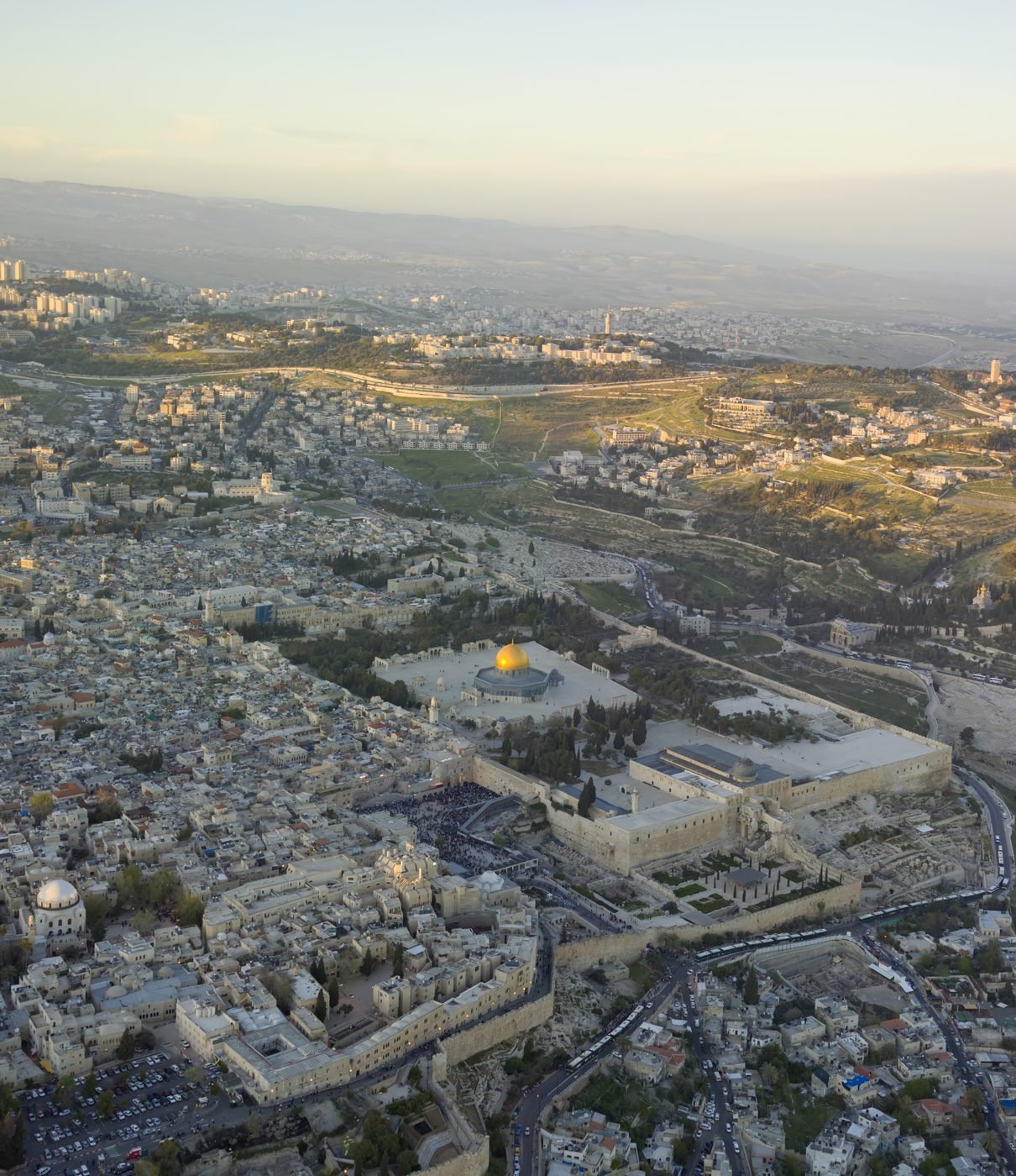
The project began around 20 BCE. The hilltop of Moriah was ancient, crowded with memories, and not remotely large enough for what Herod envisaged. So he squared it off and doubled it. He drove retaining walls deep and filled the slopes behind them to create a vast artificial platform - roughly 500 by 300 metres at the finished extent - and on that stage he rebuilt the Temple itself to a height and finish that made the old structure, already honourable, look provisional. Josephus, who had seen it and who knew hyperbole was usually unnecessary when describing Herod's work, wrote that the Temple gleamed so white and gold in the sunrise that approaching pilgrims had to shade their eyes.
The record
Flavius Josephus, writing in the late 1st century CE in Jewish Antiquities (Book XV, 380-425) and The Jewish War (Book V, 184-247), gives the most detailed surviving account of Herod's construction. He records that the Temple portico columns were so large that three men with arms outstretched could not encircle one, and that the white marble and gold leaf of the sanctuary could be seen from a distance of a full day's journey. The Babylonian Talmud, tractate Sukkah 51b, adds: "He who has not seen the Temple of Herod has never seen a beautiful building in his life." Both texts derive from people who knew the structure before its destruction in 70 CE.
What makes this more than a vanity project is that Herod was constrained. Jewish law governed who could enter the sanctuary proper and in what state of purity. Gentile workers were not permitted in the innermost courts, so Herod trained a thousand priests as masons and set them to work on the holiest sections. He agreed not to demolish the old building until the replacement was ready to rise. He understood, or was advised by people who understood, that the Torah was not a detail to be managed around - it was the entire point. Strip the project of its faithfulness to the law and you had simply built an expensive ruin. The care he took is recorded: Josephus notes that during the entire rebuilding of the inner sanctuary, rain fell only at night so that the labourers were not impeded by day. The tradition chose to remember that as providence. Perhaps it was.
The record
Archaeological excavations south and west of the Temple Mount, led by Benjamin Mazar from 1968 and continued by Eilat Mazar and the Israel Antiquities Authority, have uncovered the monumental staircase approaching the southern Hulda Gates, paving stones of the Herodian street, and the base of Robinson's Arch - the spring of a great viaduct that once carried an arched bridge from the western retaining wall across the Tyropoeon Valley to the upper city. The ashlar courses of the western wall itself run to stones weighing between two and eight tonnes; one stone, near the base of the southern section, measures approximately 13.6 metres long and weighs an estimated 570 tonnes - among the largest building stones used in antiquity. These details are documented in Benjamin Mazar's The Mountain of the Lord (1975, Doubleday) and in the Israel Antiquities Authority's published excavation reports from the Archaeological Park at the Southern Wall.
There is a particular satisfaction in the survival of Robinson's Arch - named for the 19th-century American biblical scholar Edward Robinson, who first identified its spring in 1838. Herod built the arch as part of a monumental entrance to the Mount from the west; the Romans destroyed it along with everything else in 70 CE; and yet the stub still juts from the wall, still readable, still carrying the memory of a staircase that once brought worshippers up from the city below. The destruction aimed at erasure. What it produced, unintentionally, was a monument to the scale of what had been there. You cannot erase something that large. You can only leave evidence of trying.
The record
One of the most striking epigraphic finds from the Temple Mount excavations is a limestone inscription fragment, now held at the Israel Museum in Jerusalem (Inv. 70.1076), which bears the Hebrew text "to the place of trumpeting" - identifying the corner where a priest stood to blow the shofar to mark the start and end of Shabbat. The inscription was found by Mazar's team in 1969, fallen into the Herodian street below, and is dated to the late Second Temple period. It is direct physical evidence of the Temple's operational life, not merely its architectural grandeur.
Herod died in 4 BCE with the outer courts still under construction - work that continued for decades after him and was not fully finished until the 60s CE, barely a generation before the Romans destroyed what had taken eighty years to build. The Talmudic observation that whoever has not seen Herod's Temple has never seen a beautiful building is not merely praise of stonework. It is a sigh across a gap. The building is gone. The Wall remains. And the Wall is doing what walls do: holding up the memory of everything that stood upon it.