There was once a Jewish kingdom in Arabia - not a small refuge or a diaspora enclave, but a genuine sovereign state that controlled the incense trade routes, minted its own coins, and held off the Byzantine and Persian empires for generations. The kingdom of Himyar occupied what is now Yemen, commanding the southern tip of the Arabian peninsula and the straits through which half the world's long-distance commerce passed. Somewhere in the late third or early fourth century CE, its ruling dynasty converted to Judaism. The inscriptions they left behind dropped the old polytheist pantheon and invoked instead the single god of Israel - the "Lord of Heaven and Earth" - in Sabaic script carved into stone across the Yemeni highlands. For roughly two hundred years, this was the ordinary condition of South Arabian royal power: Jewish kings, Jewish court culture, Jewish inscriptions.
The last of those kings bore the throne name Dhu Nuwas - "he of the sidelocks" - and his given Hebrew name was Yusuf. He came to power around 518 CE at a moment when his kingdom was caught between two imperial giants. The Byzantine Empire, the Christian successor to Rome, was pushing its influence southward through its client kingdom of Aksum in Ethiopia. Aksum had already occupied parts of Himyar once before. Dhu Nuwas understood what was coming. He made his move first.
The record
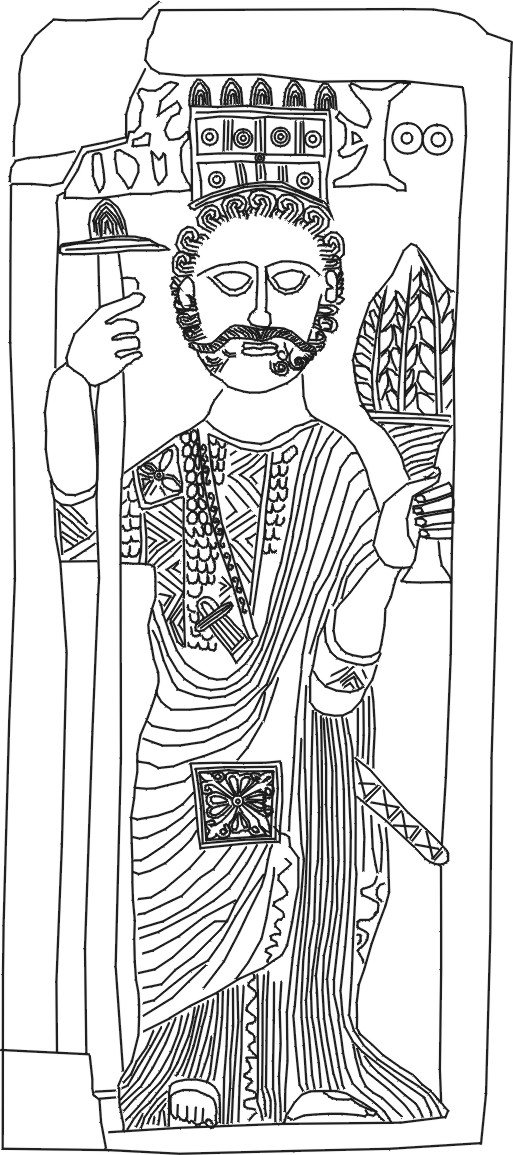
The Himyarite conversion to Judaism is confirmed by a series of South Arabian inscriptions dating from the late third to early sixth century CE. A key document is the Ryckmans 508 inscription (also known as Ja 1028), a foundation text from around 380 CE that invokes "Rahmanan" - "the Merciful One", a South Arabian monotheistic divine epithet - and explicitly rejects the earlier polytheist pantheon. Hundreds of South Arabian inscriptions from this era use exclusively monotheistic formulae drawn from Jewish tradition. The corpus has been studied extensively by Christian Robin of the French National Centre for Scientific Research (CNRS), whose 2004 survey in the journal Arabica identified more than 150 inscriptions attesting to the Himyarite Jewish period. Many of the original stones are held in the National Museum of Yemen in Sana'a and the Louvre-Lens collection in France.
Around 522-523 CE, Dhu Nuwas moved against Najran, a city in the northern highlands that had become a centre of Christian community within his kingdom. The sources are clear that there was a military and political dimension - Najran had ties to Aksum and to the Byzantine network that was steadily encircling Himyar - but they are also clear about the outcome: the city's Christian population was given a choice, and those who refused to convert were executed. The sources differ on the numbers and circumstances, but the event became famous across the Byzantine and Persian world almost immediately. Simeon of Beth Arsham, a Syriac bishop who interviewed survivors and wrote up his account within a year or two of the massacre, sent letters describing what had happened to bishops across the region. The Martyrs of Najran, as the Christian world named them, were canonised. Dhu Nuwas became, in Byzantine eyes, the villain of the age. In the same moment, he became the last Jewish king standing in Arabia - because the massacre gave Aksum and Byzantium their pretext.
The record
The events at Najran are documented in multiple independent contemporary sources. The "Book of the Himyarites", a Syriac text compiled from eyewitness accounts around 530 CE and preserved partially in a sixth-century manuscript now held in the British Library (Additional MS 17,192), records names, dates, and individual testimonies of those killed. A second independent account, the "Letter of Simeon of Beth Arsham" (c. 524 CE), survives in Syriac and Greek recensions and was circulated diplomatically to mobilise Byzantine-backed response. The Martyrologium Romanum's entry for the Najran martyrs derives from these sources. Epigraphic confirmation comes from the Marib Dam inscription (Ja 1028), which records Dhu Nuwas's own account of military campaigns in the Najran region, naming the king as Yusuf As'ar Yath'ar. Christian Robin and others have cross-referenced the Syriac letters against the Sabaic inscriptions to establish a working chronology (Robin, "Himyar et Israël", in Comptes rendus des séances de l'Académie des inscriptions et belles-lettres, 2004).
The end came quickly. The Ethiopian king Kaleb of Aksum, backed by Byzantine money and ships, crossed the Red Sea with a large army in 525 CE. The two forces met somewhere on the Himyarite coastal plain. Dhu Nuwas's army was beaten. The accounts of what happened next have the quality of legend, but later tradition remembers the last Jewish king of Arabia riding his horse into the sea and not turning back. The Aksumite army entered Zafar, the Himyarite capital. The Jewish kingdom was over. Kaleb installed a Christian viceroy, and South Arabia remained under Ethiopian influence for the next several decades. Within a century, the whole peninsula would be reshaped again - this time by a new faith born in the Hejaz. The short-lived Christian Himyar gave way, in turn, to Islam.
The record
Dhu Nuwas's final defeat and death are recorded in Procopius of Caesarea's "History of the Wars" (Book I, chapters 19-20, written c. 545-553 CE), which gives a detailed account of the Byzantine-Aksumite strategy and the subsequent conquest of Himyar. Procopius describes "Esimiphaeus" (Kaleb of Aksum) crossing the Red Sea and defeating "Dunaan" (Dhu Nuwas) in battle. The Aksumite victory inscription of Kaleb (known as the Monumentum Adulitanum, fragmentarily preserved in Cosmas Indicopleustes' "Christian Topography", c. 550 CE) records campaigns in Arabia. The Zafar region, seat of the Himyarite capital, has been excavated by a German-Yemeni mission whose finds - including South Arabian inscriptions and Aksumite-period layers - are published by Paul Yule and colleagues in the Deutsches Archäologisches Institut series (Yule, Zafar: Capital of the Ancient Himyarite Empire, 2013).
What survives of the Jewish kingdom of Himyar is mostly stone - inscriptions in a script that takes some patience to learn, recording dedications and victories and divine invocations in a language that mixes Sabaic grammar with Hebrew theological vocabulary. The scholars who work on them, people like Christian Robin, have spent careers reconstructing a chapter of Jewish history that sat entirely outside the mainstream narrative for a very long time. The tribe, as it turns out, was not confined to a narrow strip of the Levant. It was in the highlands of Arabia too, running a kingdom, minting coins, trading across oceans - and choosing, at the end, to go down on its own terms rather than bend.
Dhu Nuwas died in 525 CE. The Najran martyrs were written into the Christian calendar. The incense routes passed to other hands. And then, a century later, the Prophet of Islam was born a few hundred kilometres north, in Mecca - in a world that had been shaped, in ways nobody had fully accounted for, by the last Jewish king of Arabia and the battles he fought along the Red Sea coast.