Antioch was the city the Roman world reached for when it wanted to say "the east". Founded around 300 BCE by Seleucus I Nicator as a capital for his slice of Alexander's broken empire, it grew into one of the three great cities of the Mediterranean, ranked by Josephus behind only Rome and Alexandria. And from very near the beginning, it had Jews in it - not at the gates, not in a ghetto, but threaded through a metropolis that was busy inventing what the eastern empire would feel like for the next seven hundred years.
This matters because diaspora is too often imagined as exile into emptiness, Jews scattered to the silent margins. Antioch is the counter-example. Here was Jewish life lived in the loudest room in the region, in a city that knew how to tax, count, govern and argue, and the Jews of Antioch did all four with it.
A community with rights on brass
According to Josephus, the Jews of Antioch held citizenship rights granted by Seleucus I himself, and were organised as a recognised politeuma - a self-governing body within the city, with its own head, the archon. Their privileges were not folk memory; they were inscribed on bronze and kept. Unlike Alexandria, Antioch had no single walled-off Jewish quarter. The community was spread across the city, concentrated in the south-west, woven into ordinary urban life rather than sealed away from it.
That integration cut both ways, and Antioch was famous for it. The synagogues here drew curious Gentiles - "God-fearers" who attended without converting - in numbers that worried the city's later Christian preachers a great deal. When John Chrysostom thundered against Christians slipping off to Jewish festivals and synagogue oaths in the 380s CE, he was not warning against a marginal sect. He was warning against the pull of a confident, attractive, deeply rooted Jewish presence that had been part of the city's furniture for centuries.
A recognised politeuma
Jewish settlement in Antioch dates from the Seleucid foundation of the city. Josephus records that the community held civic rights from Seleucus I Nicator and functioned as a legally recognised self-governing body led by an archon, with its privileges preserved on brass tablets. By the first century CE Antioch held one of the largest Jewish populations of the Roman east.
Josephus, Jewish War & Antiquities; Jewish Encyclopedia: AntiochDiaspora is usually pictured as exile into silence. Antioch was a Jewish life lived in the loudest city in the east, and it held its place there for seven centuries.
The shrine of the Maccabean martyrs
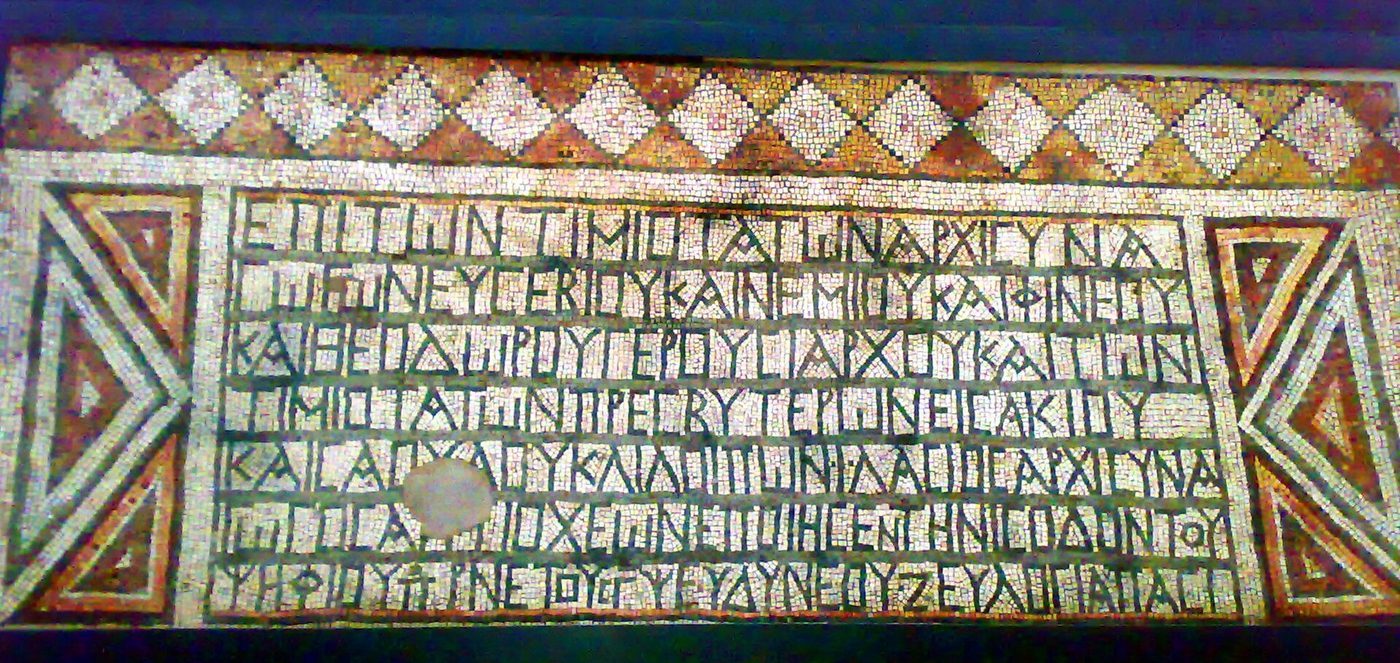
Antioch's Jewish quarter, the Kerateion, held a shrine traditionally honouring the mother and seven sons martyred under Antiochus IV, mourned in the synagogue with fasting. In the late fourth century CE the cult was claimed for Christianity and a church of the Maccabees built over the site - a vivid trace of how central, and how contested, the city's Jewish life had become.
Homilies of John Chrysostom; Jewish Virtual Library: AntiochThe long argument of the city
Antioch's Jewish story did not end with the rise of Christianity, though the climate hardened. Imperial law tightened around Jews across late antiquity, and Antioch saw its share of riots and reversals. Yet Jewish life in and around the city persisted into the Byzantine period and beyond, surviving Persian sack, earthquake and the Arab conquest of the seventh century, which folded the region into a new world without erasing the people in it.
What Antioch records, in the end, is not a single dramatic exit but a very long tenancy. For the better part of a millennium the Jews here were neither guests nor curiosities. They were citizens of one of antiquity's great cities, with their rights on metal and their festivals on the calendar, holding their corner of a place that everyone wanted and no one owned alone. The map of empire ran straight through them, and they stayed put on it.
Further reading